Showing posts with label Secrets. Show all posts

Tuesday, April 5, 2011

The original Mickey and Minnie Costumes

Q: I'm watching the Disneyland: Secrets, Magic, and Stories DVD and just watched the footage with the original Mickey and Minnie costumes (the ones that looked a lot like Halloween costumes as the narrator noted). I wanted to know if Disney still has these costumes saved or are they lost to history?
Ryan-Philipp, North Hills, California


A [Dave Smith]: The character costumes used at Disneyland on opening day were borrowed from the Ice Capades and later returned to them.


[Marcio Disney]


Click Here to see the Characters Costumes throughout the Years at the Jim Hill Media! 

Wednesday, September 1, 2010

Display for Disney's Return to Oz Characters

Q: I'm a huge fan of Disney's Return to Oz film. I saw the Tik Tok and Tin Man characters from the feature film in a 102 Dalmatians behind-the-scenes attraction at MGM studios in Walt Disney World. As both a fan of the movie and a memorabilia collector, are these characters still being preserved by your studios? Will these characters be making an appearance any time in the future?
Scott, Chicago, Illionois

A [Dave Smith]: Yes, we are very proud to have a very comprehensive representation of artifacts from Return to Oz, including Dorothy's costume, complete with her ruby slippers, and her lunch pails. We also have the Tin Woodsman, Jack Pumpkinhead and even the Gnome King's ruby slippers. Tik Tok was on display for many years at Disney's Hollywood Studios; Disney archivist Rob Klein is currently restoring him as there are plans to use him in an upcoming Archives exhibit.


Everyday, Disney fans send dozens of questions for Disney Chief Archivist Dave Smith. Here are Dave's answers to your questions. Check back every day for a new post with a new question.

Dave Smith (born October 13, 1940) was the Walt Disney Archives founder and chief archivist which is located in the Frank G. Wells Building at Walt Disney Studios in Burbank, California. He joined the company June 22, 1970. Forty years later, on July 2010, he retired.


ºoº
ºoº Marcio Disney Family Sites Network ºoº

Disney's Dream Makers

Disney Picture of the Day

Vinylmation of the Day

Disney Tales [5 Weekly tales]

The Disney History

Marcio Disney Blog

Disney Pin of the Day

Marcio Disney Digital Media

Wednesday, August 18, 2010

Alice in Wonderland - The Second Star to the Right

Q: I have heard rumors about lyrics to "The Second Star to the Right" that were not used. I also heard they had something to do with Alice in Wonderland. Could you tell me about them?
Gabrielle, Houston, Texas

A [Dave Smith]: Composer Sammy Fain, with lyricist Bob Hilliard, wrote some of the songs for Alice in Wonderland, including one called "Beyond the Laughing Sky." It was not used in Alice, but since Sammy Fain was also the primary composer on Peter Pan, and presumably everyone liked the melody he had written earlier, new lyrics were written by Sammy Cahn and it became "The Second Star to the Right."

[Marcio Disney]


Sammy Fain
[Credit: Archive Photos]

Here's a new version for the song! Just Push Play - It's Free :-D


Lyrics
The Second Star To The Right
(Thanks to 50bop for the correct lyric!)
The second star to the right shines in the night for you
To tell you that the dreams you plan
Really can come true
The second star to the right
Shines with a light so rare
And if it's neverland you need
Its light will lead you there
Twinkle Twinkle little star so we'll know where you are
Gleaming in the skies above lead us to the land we dream of
And when our journey is through each time we say goodnight
we'll thank the little star that shines
the second from the right


Why does the whispering wind
Sound like a lullaby?
Is that the magic music
From beyond the laughing sky?
Why can't the swallows remain
Where is the place they fly?
Why can't I go along with them
Beyond the laughing sky?
If I climbed the highest tree
Where, oh, where would I be?
Would I find a place for me
In the land Of grand enchantmen?
Where do the clouds disappear
When they go rolling by?
I'm wondering about the world
Beyond the laughing sky


Tuesday, August 17, 2010

The Roll-A-Book Dumbo

Q: My daughter's favorite character has always been Dumbo. How did the movie of the same name come to be made, and on what was it based?
Duane, Golden, Colorado

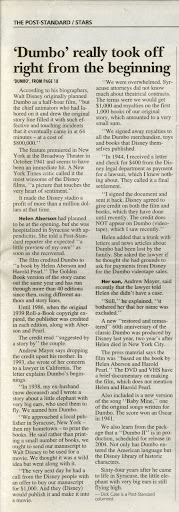
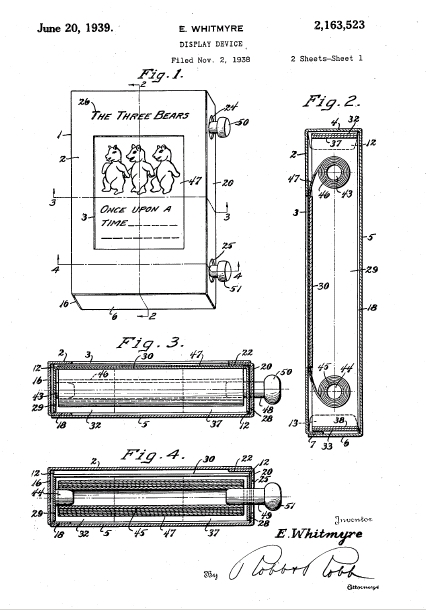
A [Dave Smith]: Dumbo was based on a story by Helen Aberson and Harold Pearl that was first published in a scroll-like item called a Roll-A-Book. None of these Dumbo Roll-A-Books have ever surfaced. After the intense work on the major productions of Snow White and the Seven Dwarfs, Pinocchio and Fantasia, Walt Disney and his artists were looking for a simple little story which they could turn into the next animated feature. Dumbo fit the bill.

[Marcio Disney]


"Dumbo the Flying Elephant is like Sleeping Beauty Castle. It is so iconic that when you see it, you know you’re looking at some place inside Disneyland park. It’s one of our classics, dating back 55 years ago. In fact, it debuted almost exactly a month after opening day on August 16, 1955. The 16 happy, grey elephants — inspired by Walt Disney’s 1941 animated film — are “piloted” by guests. These baby pachyderms can fly as high as 17 feet! Did you know that the Dumbo attraction is also at the Magic Kingdom at Walt Disney World (1971), Tokyo Disneyland (1983), Disneyland Paris (1992) and Hong Kong Disneyland  (2005)? Here’s another fun fact: When President Harry S Truman (a staunch Democrat) visited the park in 1957, he playfully refused to ride Dumbo because of the Republican symbolism associated with the elephant-themed attraction. Enjoy this historical footage of our famous flying elephants."


ESSAYS

Early Dumbo sketches

The Mysterious Dumbo Roll-A-Book

 
When I wrote in a January 14, 2010, post about the history of the black crows in Dumbo, I reached back as far as the 102-page treatment that Joe Grant and Dick Huemer submitted to Walt Disney in the early months of 1940, in installments. But Dumbo's history goes back further than that, as Huemer himself acknowledged in his interview with Joe Adamson, part of which I published in Funnyworld No. 17. Adamson asked, "Where's the story that Dumbo comes from?" and Huemer replied:
I never saw it, but they say it was on a little strip that was given away on a cereal box. Or maybe it was even printed on the outside, I don't know. But it had the basic elements of the story: the little elephant who had big ears, was made fun of, learned to fly, and was redeemed. All in just a few panels. Well, we took it from there, had a few story meetings, then Joe Grant and I wrote it up a chapter a time and submitted it to Walt. He used to come down and say, "That's coming along good,. We'll make it!"
Then we got sketch men and story men and went to work and put together what we call a Leica reel. A Leica reel was a way of presenting a storyboard with the individual pictures on a filmstrip that was run through a Leica projector. You'd flip over a picture and talk about it, then flip over the next. ...
This was how we often held a story meeting. Sometimes we had rough Leica reels in pencil, and later we would make a color reel.
Adamson: When you first got Dumbo, what form was it in?
Huemer: Somebody had started working on it and there were quite a few sketches that I remember, but no storyboards yet. Mostly talk, getting together with Walt, and taking notes, and studying them. Dumbo was put aside a while to concentrate on another picture, I suppose, then Joe Grant and I picked it up.


Please! Read the rest of this AMAZING article by visiting: http://www.michaelbarrier.com/Essays/DumboRollABook/DumboRollABook.html


Everyday, Disney fans send dozens of questions for Disney Chief Archivist Dave Smith. Here are Dave's answers to your questions. Check back every day for a new post with a new question.

Dave Smith (born October 13, 1940) was the Walt Disney Archives founder and chief archivist which is located in the Frank G. Wells Building at Walt Disney Studios in Burbank, California. He joined the company June 22, 1970. Forty years later, on July 2010, he retired.


ºoº
ºoº Marcio Disney Family Sites Network ºoº

Disney's Dream Makers

Disney Picture of the Day

Vinylmation of the Day

Disney Tales [5 Weekly tales]

The Disney History

Marcio Disney Blog

Disney Pin of the Day

Marcio Disney Digital Media

Monday, August 16, 2010

The Last Thing Walt Wrote

Q: Is it true that the last thing Walt Disney did before he died was write the words "Kurt Russell"?
Victor, Chicago, Illinois

A [Dave Smith]: Not exactly. On his desk was a notepad on which he had scrawled some notes about future films and television shows. One of the names that he wrote was "Kurt Russell." The notes are undated, but are certainly among the last things he wrote in his office. When Kurt was at the Studio filming Now You See Him, Now You Don't, I took him up to Walt's office to show him the notes.


Sunday, August 15, 2010

Donald's Toothbrush Holder

Q: I have an early Donald Duck figurine. It is either a chalk holder or a pencil holder. It is approximately 2 3/4" wide and about 5" high. On the back it says c (which is in a circle) Walt E. Disny (note spelling) and on the bottom it says "Made in Japan." As I look at it, Donald is looking to the left, and his right hand is touching the brim of his hat (U.S. Navy) as if saluting. His bowtie is red, his hat and sleeves have a black ring around them. Do you have any information on this? Thank you!
Linda, Rochester, New York

A [Dave Smith]: That item is actually a toothbrush holder, made in Japan around 1935 and distributed in the U.S. by the George Borgfeldt Co. There were a number of similar toothbrush holders, also featuring Mickey Mouse, Minnie Mouse, Pluto and the Three Little Pigs.


Saturday, August 14, 2010

The 70s Electrical Water Pageant

Q: I remember seeing the Electrical Water Pageant at the Contemporary Resort at Walt Disney World in the 1970s and I've heard that its development eventually led to the development of the Main Street Electrical Parade. Was the original music used for the show a version of "Baroque Hoedown," the song later (and still) used for the Main Street Electrical Parade?
Alan, Chicago, Illinois

A [Dave Smith]: "Baroque Hoedown" was indeed originally used by the Electrical Water Pageant in 1971, but in 1972 it was transferred to the Main Street Electrical Parade at Disneyland. Over the almost four decades that the Pageant has been operating, the music it uses has changed many times.


[More Info by Marcio Disney]


This is a vacation video took on feb 23 - mar 1st, 1975.

The music played is a rare recording of the original Electrical Water Pageant (The Electrical Water Pageant is played at night during the light show on Seven Seas Lagoon Lake. It includes footage during the 4th year it was open (Opened 10/1/71), including the Main Street Parade, It's a Small World, and The Hall of Presidents.

The music as heard here was used only in the original 1972 parade at Disneyland and never played in the WDW version!


Friday, August 13, 2010

Donald Duck Orange Juice

Q: In December 1976 my family went to Walt Disney World and there was a place called the Donald Duck Juice Factory with the name on a water tower. In 2008 I returned there and noticed a water tower at Downtown Disney that looked just like the tower I remember. Is that where the juice factory used to be?
Robert, Baldwin, Wisconsin

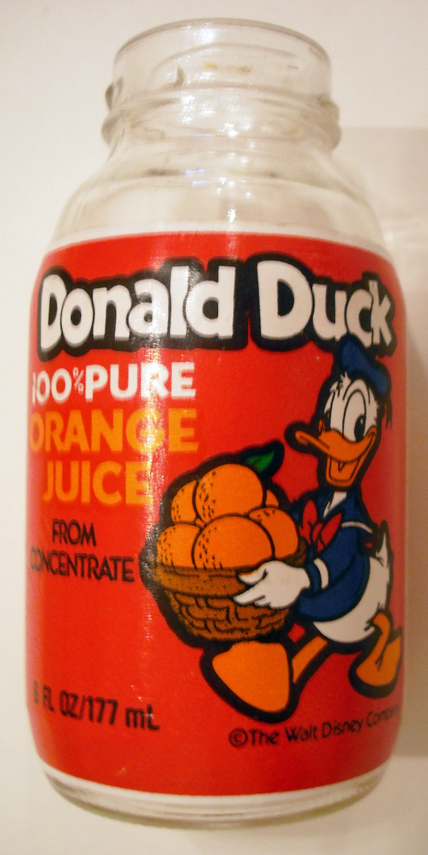
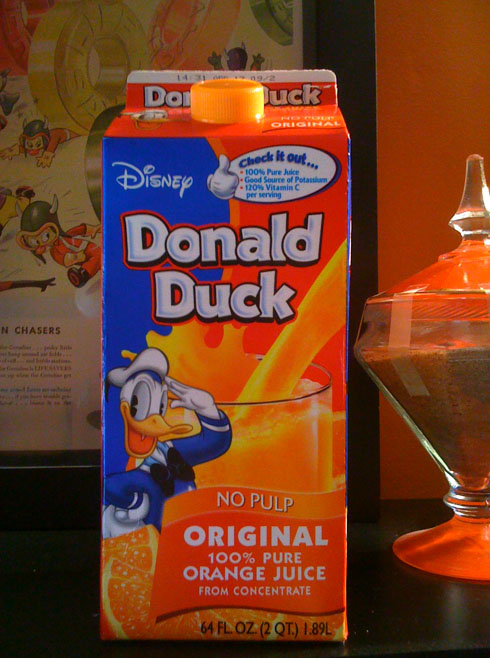
A [Dave Smith]: Would you be thinking of Citrus World, Inc., headquartered in Lake Wales, Florida, not far from Walt Disney World? That is where Donald Duck orange juice is packaged. I do not remember a water tower, but I do remember a large billboard with Donald Duck on the roof of their building back in the 1970s.

[Marcio Disney]


Do you remember the commercial?


WORLD WAR II

"Sixty boxcars of fresh citrus fruit a day are being processed by Florida Citrus Canners Cooperative at Lake Wales. About 40 of those boxcars of fruit are converted into 8,000 gallons of orange concentrate destined exclusively for the United States armed forces and their allies. Total volume of concentrate was expected to reach 800,000 gallons. When reconstituted on the basis of 7 gallons of water to a gallon of concentrate, it will produce 6.4 million gallons of juice with vitamins added.


All will be shipped under the coop's Donald Duck brand. Concentrate production has been boosted by the need to reduce shipping space. Concentrate requires only about one-eighth of what fresh fruit requires. "]"Sixty boxcars of fresh citrus fruit a day are being processed by Florida Citrus Canners Cooperative at Lake Wales. About 40 of those boxcars of fruit are converted into 8,000 gallons of orange concentrate destined exclusively for the United States armed forces and their allies.


Total volume of concentrate was expected to reach 800,000 gallons. When reconstituted on the basis of 7 gallons of water to a gallon of concentrate, it will produce 6.4 million gallons of juice with vitamins added. All will be shipped under the coop's Donald Duck brand. Concentrate production has been boosted by the need to reduce shipping space. Concentrate requires only about one-eighth of what fresh fruit requires. "


Thursday, August 12, 2010

"My Dad, Walt Disney" by Diane Disney Miller

Q: Walt Disney was the mystery guest on the November 11, 1956 episode of What's My Line? At the end of the show, he tell us that next week, The Saturday Evening Post will feature an article written by his daughter about Walt Disney. I would love to read this article and know more about it.
Marcio Disney, Rio de Janeiro, Brazil

A [Dave Smith]: Walt referred to the serialized version, "My Dad, Walt Disney," of Diane Disney Miller's biography of her father. It appeared in The Saturday Evening Post for 7 weeks, beginning on November 24, 1956. The book version was entitled The Story of Walt Disney.


[More from Marcio Disney]

Actually it started on November 17, 1956 and you can read the original First and Last [January 5, 1957] article in the PDF below:


And here you can see the "What's My Line" episode with Walt Disney as the Mystery Guest!


Wednesday, August 11, 2010

Donald's Big Imagination

Q: I had a wonderful Donald Duck comic in which he traveled through space and went to stars. He was largest on Betelgeuse (I think) and smallest on another star. Imagine my surprise when I found out that both of the stars he visited were REAL stars. Do you know what the comic issue was and is it anywhere I can read again?
Erica, Brooklyn, New York

A [Dave Smith]: That story is the lead story in Walt Disney's Comics and Stories, #199 (April, 1957). You might be able to find the comic in a used comic book store or on eBay (there are a number of copies available there as I am writing this).


[More Info by Marcio Disney]

This is the cover of the Walt Disney's Comics and Stories #199 and the story is a 10 pages story with 4 rows per page and it's called Donald's Big Imagination.

Character Appearances: Donald Duck, Gyro Gearloose, Gyro's Helper, Huey Dewey and Louie

After the cover below, you can read the complete story. Please, be patience while the PDF file automatic loads!


Monday, August 2, 2010

Seven Dwarfs - The Original Names

Q: What were the original names chosen for the seven dwarfs?
Vicky, Ontario, California

A [Dave Smith]: In 1934, the names first selected were Wheezy, Jumpy, Baldy, Grumpy, Doc, Happy and Sleepy. Four of those names were retained. Dozens of other names were suggested, with a few being Hickey, Sniffy, Stuffy, Burpy, Tubby, Shorty and Dizzy.


[More to Know About Snow White by Marcio Disney]

Deafy is a happy sort of fellow - he always tries to make clever remarks, but he misinterprets other people's attitudes toward him. He feels, lots of times, that they are saying something about him, or that they have made some remarks, which they haven't at all - he takes exception to the most ridiculous things. Throughout the picture Deafy and Grumpy  are always clashing. Deafy will pick up one word of the conversation in the early part, and whereas the conversation topic might have changed completely, he still sticks to the first thing that he heard, and in this way we hope to get some comical situations out of Deafy.
—Story draft for Snow White and the Seven Dwarfs, made in early 1936.


Differences from fairy tale

Though Disney's Snow White and the Seven Dwarfs is similar to the fairy tale version, there are several differences. In the fairy tale, Snow White's mother wishes for a child with "lips as red as blood, hair as dark as the window frame, and skin as white as snow". This does not occur in the film, as Disney's Snow White is shown with only her stepmother, the Queen, and there is no scene of her biological mother.

In the fairy tale, Snow White accepts three gifts from the witch (a girdle, a poisoned comb, and the apple), but is rescued from the first two gifts by the dwarfs. When she is offered the apple, she is unwilling to eat it and only accepts after the witch takes a bite of the apple that is not poisoned. However, in the film, Snow White only accepts one gift (the apple) from the witch after she helps the witch inside the dwarfs' house (some of the woodland birds attacked the witch as a warning, which was misinterpreted by Snow White). She bites the apple after being told that the apple is magical and that one bite will make all of her dreams come true (namely marrying the Prince).

In the fairy tale, Snow White is not awakened by the prince's kiss. Instead, the prince buys the coffin and Snow White's body from the dwarfs and has it carried with him towards his castle. During the journey, a piece of apple in Snow White's throat becomes dislodged and she awakens.

Lastly, in the fairy tale, Snow White faces her stepmother one final time after eating the poisoned apple. The stepmother attends the wedding of Snow White and the prince, but she is stopped from causing further harm by being forced to wear hot iron shoes to her death. In the film, the stepmother (as the witch) is chased up to the top of a mountain by the dwarfs after giving Snow White the poisoned apple: when she tries to dislodge a boulder onto the dwarfs to kill them, lightning strikes the edge she is standing on and she falls to her death, along with the boulder falling and presumably crushing her.


Wikipedia

Snow White and the Seven Dwarfs is a 1937 American animated film based on Snow White, a fairy tale by the Brothers Grimm. It was the first full-length cel-animated feature in motion picture history, as well as the first animated feature film produced in America, the first produced in full color, the first to be produced by Walt Disney, and the first in the Walt Disney Animated Classics canon.[3]

Snow White and the Seven Dwarfs premiered at the Carthay Circle Theatre on December 21, 1937, and the film was released to theaters by RKO Radio Pictures on February 4, 1938. The story was adapted by storyboard artists Dorothy Ann Blank, Richard Creedon, Merrill De Maris, Otto Englander, Earl Hurd, Dick Rickard, Ted Sears and Webb Smith from the German fairy tale Snow White by the Brothers Grimm. David Hand was the supervising director, while William Cottrell, Wilfred Jackson, Larry Morey, Perce Pearce, and Ben Sharpsteen directed the film's individual sequences.

Snow White and the Seven Dwarfs was one of only two animated films to rank in the American Film Institute's list of the 100 greatest American films of all time in 1997 (the other being Disney's Fantasia), ranking number 49. It achieved a higher ranking (#34) in the list's 2007 update, this time being the only traditionally animated film on the list. The following year AFI would name the film as the greatest American animated film of all time and the best ever Walt Disney Animated Classics movie.

In 1989, the film was added to the United States National Film Registry as being deemed "culturally, historically, or aesthetically significant".


The names of the Seven Dwarfs (Bashful, Doc, Dopey, Grumpy, Happy, Sleepy and Sneezy) were created for this production, chosen from a pool of about fifty potentials. The one name Disney always had in mind from the start was Grumpy, or something similar. Blabby, Jumpy, Shifty, and Snoopy were among those that were rejected, along with Awful, Baldy, Biggo-Ego, Biggy, Biggy-Wiggy, Burpy, Busy, Chesty, Cranky, Daffy, Dippy, Dirty, Dizzy, Doleful, Flabby, Gabby, Gloomy, Goopy, Graceful, Helpful, Hoppy, Hotsy, Hungrey, Jaunty, Lazy, Neurtsy, Nifty, Puffy, Sappy, Sneezy-Wheezy, Sniffy, Scrappy, Silly, Soulful, Strutty, Stuffy, Sleazy, Tearful, Thrifty, Tipsy, Titsy, Tubby, Weepy, Wistful, and Woeful.


It was called "Disney's Folly." Who on earth would want to sit still for 90 minutes to watch an animated cartoon? And why pick a well-worn Grimm's Fairy Tale that every schoolkid knows? But Walt Disney seemed to thrive on projects which a lesser man might have written off as "stupid" or "impossible". Investing three years, $1,500,000, and the combined talents of 570 artists into Snow White and the Seven Dwarfs, Disney produced a film that was not only acknowledged a classic from the outset, but also earned 8,500,000 depression-era dollars in gross rentals. Bypassing early temptations to transform the heroine Snow White into a plump Betty Boop type or a woebegone ZaSu Pitts lookalike, the Disney staffers wisely made radical differentiations between the "straight" and "funny" characters in the story. Thus, Snow White and Prince Charming moved and were drawn realistically, while the Seven Dwarfs were rendered in the rounded, caricatured manner of Disney's short-subject characters. In this way, the serious elements of the story could be propelled forward in a believable enough manner to grab the adult viewers, while the dwarfs provided enough comic and musical hijinks to keep the kids happy. It is a tribute to the genius of the Disney formula that the dramatic and comic elements were strong enough to please both demographic groups. Like any showman, Disney knew the value of genuine horror in maintaining audience interest: accordingly, the Wicked Queen, whose jealousy of Snow White's beauty motivates the story, is a thoroughly fearsome creature even before she transforms herself into an ancient crone. Best of all, Snow White  clicks in the three areas in which Disney had always proven superiority over his rivals: Solid story values (any sequence that threatened to slow down the plotline was ruthlessly jettisoned, no matter how much time and money had been spent), vivid etched characterizations (it would have been easier to have all the Dwarfs walk, talk and act alike: thank heaven that Disney never opted for "easy"), and instantly memorable songs (Frank Churchill, Leigh Harline, Paul J. Smith and the entire studio music department was Oscar-nominated for such standards-to-be as "Whistle While You Work" and "Some Day My Prince Will Come")


Related Posts Plugin for WordPress, Blogger...