We recently enjoyed a second dinner at Club 33. We were told by a hostess that the restaurant was completed in 1967. But after leaving, I thought to myself, “How could Mr. Disney sit at a table and watch the guests in New Orleans Square below him in 1967 when he died in 1966?” Could you straighten out the timeline of the Club 33 construction and completion for me?
Walt Disney never had a chance to sit in Club 33 and watch his guests below in New Orleans Square (as depicted in a well-known piece of artwork), because he died six months before the club was finished. He was very involved in the early planning of the club, and he and his wife, Lilly, had traveled to New Orleans with the club’s designer, Emile Kuri, to select the beautiful antiques to be featured there. But he never got to see the results as he died on December 15, 1966. The club opened on June 15, 1967.
Walt Disney and his staff made intensive surveys of Florida, looking for the right amount of available and affordable land, proximity to Interstate Highways, ease of access, etc. It was deemed that area between Ocala and Orlando experienced a significant decline in minimum winter temperature; because cold nights tend to have an adverse effect on attendance and landscaping, the region south of Orlando was more appealing. It was the Orlando area property that fulfilled their needs.
Could you please tell us about the history and development of Figment and the Dreamfinder, originally from Journey into Imagination?
Dreamfinder and Figment originated as Professor Marvel and his green dragon friend at the proposed, but never built, “Discovery Bay” expansion of Disneyland. When Kodak signed on to be the sponsor of Epcot’s Journey into Imagination, the characters were re-imagined. Professor Marvel became the Dreamfinder, and his green dragon became Figment, who adopted royal purple pigment. Dreamfinder was developed as the kind, wise spirit of imagination (with the attitude of Santa Claus or The Wizard of Oz), and Figment became just the opposite—the curious and childish sidekick with a short attention span.
Walt Disney initially had two of the Audio-Animatronics® Abraham Lincolns constructed. The one for the 1964 World’s Fair so impressed Mr. Disney that he had the second made for Disneyland. Whatever happened to the original that was displayed at the World’s Fair?
The very first Abraham Lincoln Audio-Animatronics® head is part of the collection of the Walt Disney Archives.
The first Disneyland version of Great Moments with Mr. Lincoln – named after the World's Fair attraction – opened on July 18, 1965, in honor of the official 10th anniversary of the park, in the new Opera House on Main Street, USA. The show in the main theater with Mr. Lincoln was a duplicate of the World's Fair attraction. The exterior and interiors of the building were given a new theme using Abraham Lincoln and Walt Disney exhibits, displays and films as the attraction was presented by Lincoln Savings and Loan Association, not the state of Illinois. It did not require an "A" through "E" attraction admission ticket. This version of the attraction ended January 1, 1973, along with the sponsorship by Lincoln Savings.
Who wrote and composed the Space Mountain song “Here’s to the Future and You”?
RCA’s song, “Here’s to the Future and You,” from 1974, had words by X. Atencio and music by Buddy Baker. Atencio and Baker also partnered on songs for other memorable attractions, including Haunted Mansion and World of Motion.
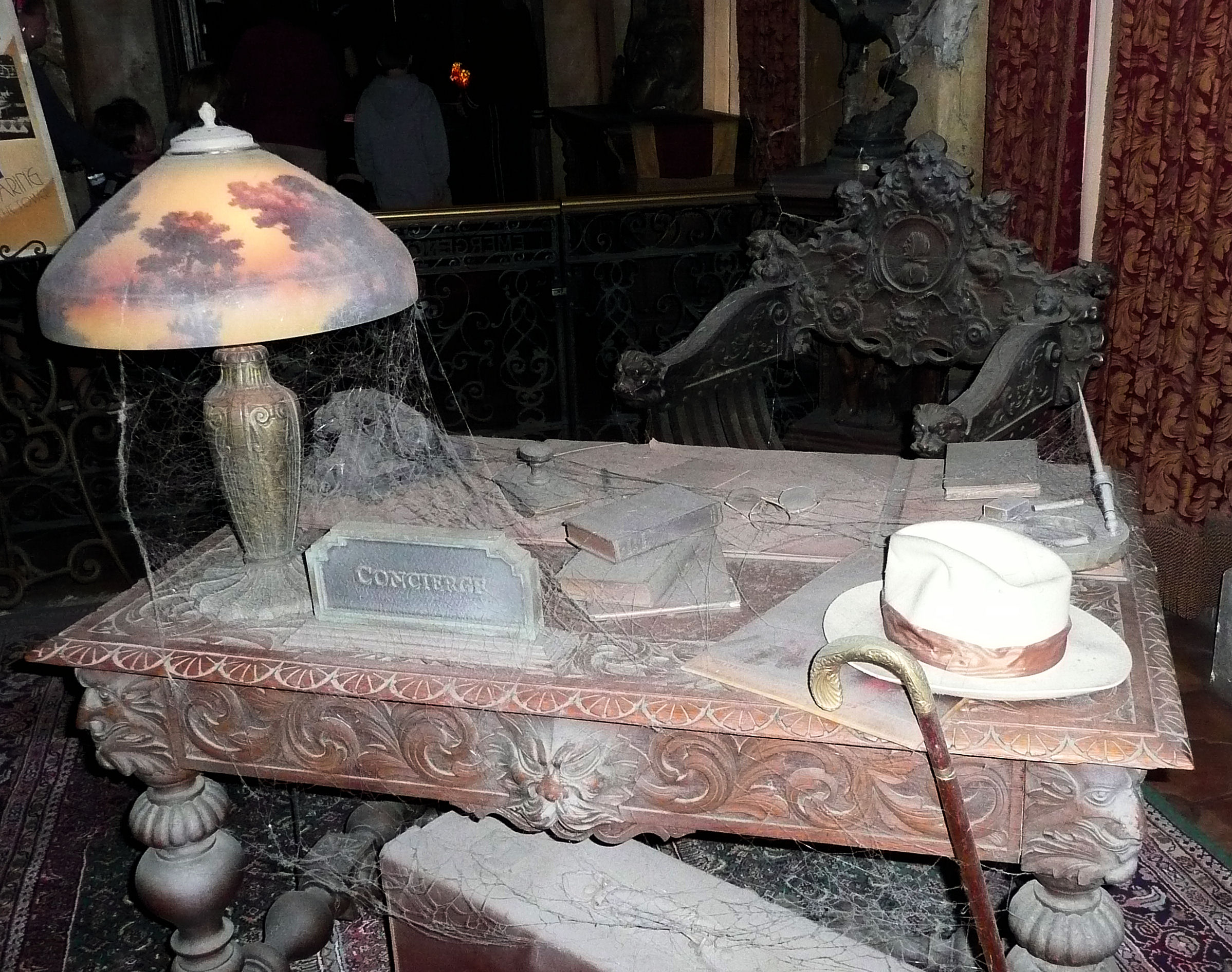
The props in the Tower of Terror are amazing! I’ve heard that the Mission Inn in Riverside, California, and the Biltmore in Los Angeles provided some of the inspiration for the design. Are there any other buildings that inspired this beautiful attraction?
The Imagineers looked at photographs of many elaborate buildings from the right era for their design ideas and then scoured Hollywood auction houses for the actual props. Some came from lavish estates of the biggest names in the entertainment industry. One set of chairs was 400 years old; other chairs came from the exclusive Jonathan Club, a well-known Los Angeles landmark built in the 1920s.
A few weeks ago, I shared my very first ticket to Walt Disney World Resort. This prompted blog reader Skip to ask if we had any photographs of the old A to E tickets used at Magic Kingdom Park. With the help of my friends at the Walt Disney Archives, I was able to track them down.
Want to take a ride on the Omnibus on Main Street, U.S.A.? Grab your A ticket and enjoy the double-decker view!
Don’t know what to do with your B ticket? Climb aboard a Mike Fink Keel Boat and sail around the Rivers of America.
That C ticket you’re holding would have been perfect to take a spin aboard Mr. Toad’s Wild Ride.
Already ridden on the Omnibus and a Mike Fink Keel Boat? Why not make it a trifecta with a voyage aboard the Admiral Joe Fowler with your D ticket?
Although all-inclusive passport tickets were introduced at Walt Disney World Resort and Disneyland park in June of 1981 in advance of ticket books being phased, we still often lovingly refer to attractions by their ticket letter.
Check out these posts for more “Vintage Walt Disney World”:
Q: There have been so many fascinating documentaries about the making of the Disney parks and individual movies, but I do not recall ever seeing a documentary about the musicians who contribute to the Disney experience with their music. Music in the parks and at their events is such an integral part of the experience. It would not be a true Disney experience without the music! Who are the people that provide these experiences for us? Cheryl, Cedar Rapids, Iowa
A [Dave Smith]: Music has indeed been an exciting part of our parks, and while there is no documentary film, the contributions of composers have been mentioned in books. At first Walt Disney used his staff composers — such as Oliver Wallace, George Bruns and the Sherman Brothers — to write the music he needed for Disneyland. Perhaps the most prolific of the composers for Disneyland and the later parks was Buddy Baker; he remained a staff composer until 1983. In more recent years there have been people like George Wilkins, Bob Moline, Don Dorsey, Russell Brower, Bruce Broughton, Joel McNeely, Edo Guidotti and Richard Bellis creating the music.
More to see at Marcio Disney History Youtube Channel [Marcio Disney]
Now we have an amazing documentary about the Sherman Brothers (which I love the most) called The Boys. Check out the trailer:
Here you can see the complete scene with the Sherman Brothers and Walt Disney together playing "It's a Great Big Beautiful Tomorrow"
A Night With Richard Sherman - I love the version of "It's a Small World" in this video :)
Q: In
1973 my wife and I visited the Magic Kingdom at Walt Disney World on our
honeymoon. We saw and loved an attraction called the Mickey Mouse Revue.
If I remember correctly it was similar to the Country Bear Jamboree. On
subsequent visits we could no longer find it. Could you tell us what happened
to it? Ronald, Boca Raton, Florida
A [Dave Smith]: TheMickey Mouse Revue, an Audio-Animatronics®
attraction featuring Disney characters performing some of the most memorable
Disney songs, was created for Walt Disney World, opening in 1971. In 1980 the
attraction was removed and sent to Tokyo Disneyland, where it played from 1983
to 2009. Mickey's PhilharMagic is now in the former location of the Mickey
Mouse Revue in the Magic Kingdom at Walt Disney World.
There´s 2 videos above about Mickey Mouse Revue. The first one is the original version in the Magic Kingdom and the second one is the Tokyo Disneyland version.
Q: In the 2007 revamp of the Walt Disney World Haunted Mansion did they replace the original Madame Leota crystal ball to make it float? And, if so, is the original in the Archives?
A [Dave Smith]: Yes, the floating Madame Leota crystal ball that was installed in the 2007 refurbishment uses an internal projection to make the effect more realistic, so the former prop was replaced. It is now part of the Archives.
Madame Leota is the spirit of a psychic medium, conducting an otherworldly séance in an attempt to summon spirits and assist them in materializing and was played by Leota Toombs (face) and Eleanor Audley (voice). Before Leota Toombs was chosen for the face of the medium in the crystal ball, Imagineer Harriet Burns was tested for the part. Leota Toombs also played the Ghost Hostess who appears at the end of the attraction, though it is unknown whether or not she and Madame Leota are meant to be the same character.
"Serpents and spiders, tail of a rat / Call in the spirits, wherever they're at. / Rap on a table, it's time to respond / Send us a message from somewhere beyond. / Goblins and ghoulies from last Halloween / Awaken the spirits with your tambourine. / Creepies and crawlies, toads in a pond / Let there be music from regions beyond. / Wizards and witches, wherever you dwell / Give us a hint by ringing a bell."
For Disneyland´s Haunted Mansion Online Audio, Click Here!
Q: On my first trip to Walt Disney World about 10
years ago, there was a parade that took the kids off the sidewalk and let them
interact and dance with the characters. What was that called, and why don't
they let kids be a part of the parade anymore?
Bridget, Brooklyn, New York
A [Dave Smith]: You are likely thinking of the Share a Dream Come
True parade, which premiered with the 100 Years of Magic celebration
in 2001. The parade invited guests to participate with characters along the
route in a series of "show stops" for a number of years. The most
recent version of the parade, Celebrate a Dream Come True, adopts a new
theme and currently does not incorporate show stops.
"Hello everyone and welcome. This is Julie Andrews and I'd like to tell you a story. In 1901 a little boy named Walt Disney was born and a dream began. The dream of imagination that today, 100 years later, has touched every one of our lives. I once had the privilege to know the dreamer, Walt Disney. His imagination inspired and built his dreams into reality for all of us to share and he made them practically perfect in every way. Today we celebrate and share the legacy of Walt Disney filled with pixie dust, princesses, fairy tales, and fantasies and above all the magic of dreams. (children's chorus sings Sharing a Dream Come True. A child enthusiastically announces) And now Ladies and Gentlemen, Boys and girls the Magic Kingdom proudly presents the Share a Dream Come True Parade."
Beginning with Mickey Mouse and ending with a fairy-tale finish, this spectacular new parade of giant Disney snow globes is a tribute to all those stories and characters that have touched our hearts through the years. It’s a flurry of classic Disney moments frozen in time. (from www.wdwmagic.com)
All the music in the show was recorded in London by members of the London Symphony Orchestra and the Royal Philharmonic Orchestra and was composed by Gavin Greenaway. It consisted of the main theme called Fantasy, as well as the Share a Dream Come True theme used for the 100 Years of Magic celebration.
All audio is controlled through DTMF tones transmitted by RF signals from the antennas on Cinderella's Castle to each unit. Each unit has its own audio themed to the unit, with the main parade theme played on the zone speakers.
Q: In Steamboat Willy, does Mickey play himself? Is the boat the only thing named Steamboat Willy? Charlotte, Topeka, Kansas
A [Dave Smith]: No, it is Mickey Mouse portraying the character of Willie, known as Steamboat Willie because he works on a steamboat. The boat has no name in the cartoon, though it docks at Podunk Landing.
Q: We were always under the
impression that Steamboat Willie was the third Mickey Mouse cartoon to
be produced, but the first one released, on November 18th, 1928.
However, a few websites note Plane Crazy as being released on May 15,
1928, six months before Steamboat Willie. Was this a true release date
or perhaps just a private viewing for distributors?
Joseph and Chrissy, Modesto, California
A [Dave Smith]:
The May 15th date was a preview of the silent version of Plane Crazy
in Los Angeles; the film did not have its official release until after
sound was added. It opened at the Mark Strand Theatre in New York on
March 17, 1929, four months after Steamboat Willie premiered.
More to see [by Marcio Disney]
Nowadays, you can see the "Steamboat Willy" boat at the AMAZING Fantasmic Finale at Disney's Hollywood Studios.
Here you can Watch this amazing short! I really love it :)
Q: One of the main birds in the Enchanted Tiki Room is José. There is also a José in The Three Cabelleros. Is the José in the Enchanted Tiki Room the same as José in The Three Caballeros? Also, who is the voice of José in both the Enchanted Tiki Room and The Three Caballeros? They both seem to have the same personalities. Bethany, Woodland Hills, California
A [Dave Smith]: No, these are different birds named José. In The Three Caballeros, it is a Brazilian parrot, José Carioca, with the voice provided by José Oliveira. In the Enchanted Tiki Room, the macaw, José, is voiced by Wally Boag, who was the original comedian in The Golden Horseshoe Revue.
[About the Birds by Marcio Disney]
Zé Carioca
Zé is short for José. Carioca is the term which refers to a person born in Rio de Janeiro, Brazil.
The Character was created by Walt Disney in Copacabana and it is VERY popular in Brazil.
The creation of a Brazilian animated character during the Second World War was part of a strategy called "Good Neighbor Policy" headed by the United States government to improve relations and gather support amongst its neighbor countries.
In April 2007, Disney re-introduced José Carioca (along with the third Caballero, Panchito), in the newly-revamped ride at Epcot's Mexico Pavilion with entirely new animation and a new storyline. It has been dubbed "The Gran Fiesta Tour". After being reunited, The Three Caballeros are set to play a show in Mexico City. But Donald goes missing. José and Panchito must search throughout Mexico for Donald as he takes in various sights around Mexico. The animation for it was apparently directed by Eric Goldberg.
José Carioca can also be seen in the Hong Kong Disneyland version of It's a Small World, which opened on April 28, 2008.
Biographical Details
Zé Carioca became so popular that he starred in two feature-length films and a cartoon short, had his own newspaper strip for two years and is a recurring guest star in the "Ducks" comic books. In his native Brazil, José is actually a leading character in his own comics, and his fame as a cultural icon is probably equivalent to that of Mickey Mouse's in the USA. In the 1940s a series of films were planned featuring José and a pretty parrot named Aurora, but they never made it past the storyboard process. However, Aurora, Joe Carioca's girlfriend (also called Rosinha [Portuguese] or Rosita [Italian]), shows up in a large number of comics done in both Holland and Brazil, so the fact that she isn't in an actual cartoon didn't stop her from becoming a star. José's best friend is a crow named Nestor, who appears to have the same relationship Goofy does to Mickey Mouse (sidekick), though José tends to take full advantage of Nestor's gullibility. Other friends include a dark-skinned dogface named Pedrao, (Pedro or Peter), and a country bumpkin duckbill named Afonsinho ("Little Alphonse"). José also has two nephews named Zico & Zeca. His arch-rival for the affections of Aurora is a rooster named Zé Galo in Portuguese [Galetto in Italian (a.k.a. Joe Cock or Joe Cockerel in English)]. Another of his typical adversaries is Aurora's father, Roca Vaz, because he disapproves of José's affection for his daughter. The Aracuan Bird, also known as the "Clown of the Jungle," and Panchito the Mexican Chicken are two other friend's of Donald and José's were introduced in "The Three Caballeros." The Aracuan appeared in two other cartoons as well and in Brazil, the Aracuan Bird stars in his own stories, in his own universe of birdbeaked characters. José made a cameo appearance in "Alice in Wonderland" where he was one of the jurors present at the Red Queen's trial of Alice.
Historical Facts
José's first name is believed to have been inspired by José Carlos de Britto e Cunha. He was Brazil's most popular editorial cartoonist by that time, and had died in the 1950's. When Walt Disney came to South America on his "good-will" mission he visited several countries and gave credit to some of the local artists like Molina Campos (Gaucho series). However, J. Carlos is not mentioned, though some people say that Disney's inspiration for the Zé Carioca concept came from a J. Carlos drawing of a parrot. If this is true, then the name "José" may have had a double inspiration from both the illustrator named José Carlos, and his film vocalist, José Oliveira. His last name, Carioca, is a Brazilian word used to describe a native of Rio de Janeiro.
After his appearance in the films "Saludos Amigos" and "The Three Caballeros" an American newspaper strip was chronicling his further adventures in the late 1940s to the mid 1950s. After that some of these tales were reprinted in "Walt Disney's Comics & Stories," but since then José has virtually disappeared from America. José and Panchito were created by the Walt Disney Studios in a gesture of friendship between North America and Latin America and, particularly in Brazil, José went on to become a very prominent cultural icon.
Brazilian comics began regularly featuring José (whom they now called Zé for short), starting with "O Pato Donald" #434 (March 1, 1960) which features a Zé Carioca story "A Volta de Zé Carioca" ("The Return of Zé Carioca"). Story begins with Zé Carioca in a plane returning to Rio de Janeiro. He has supposedly spent the past ten years in Hollywood as a famous film star and felt it was time to return home. However, once he deboards the plane no one seems to recognize him. When he goes after some of his creditors they think he is an imposter. It's Carnaval (a Brazilian strong tradition). He enters a masquerade contest to win the cash prize because he is now starving, but he places LAST place as Zé Carioca impersonator! A ship arrives with American tourists, among whom are many of his friends: Donald, Daisy, Mickey, $crooge, the Nephews, Minnie and even Brer Rabbit, Tinker Bell, the Three Little Pigs and Pluto. They recognize him but no one wants to hire him as a tour guide. Soon he spots another group comprised of the Beagle Boys, Captain Hook, the witch from Snow White, Big Bad Wolf and Brer Rabbit's nemeses. Nearly every bad guy in Disney Universe. He discovers that the crooks' plan is to capture all the good guys. The bad guys succeed in kidnapping the Mickey, Donald and the rest and take them to Hook's ship. Nobody believes Zé when he tells the police, because everybody thinks he's still an imposter. Finally Zé saves everybody with the help of Tinker Bell's magic fairy dust. After that everybody finally believes he's the REAL Zé Carioca. Jorge Kato was the first Brazilian artist for Zé Carioca.
His next Brazilian appearance is in his own comic book title "Zé Carioca" which is actually the alternate title to "O Pato Donald," apparently renamed in Zé's honor. First Zé Carioca issue was dated Jan. 10, 1961 issue is #479 (numbering followed O Pato Donald's numbering). On the cover of that issue Zé Carioca is playing football (soccer). The main story is "Zé Carioca Contra o Goleiro Gastao" ("Joe Carioca vesus Gladstone for the goal"). Donald, Daisy, the Nephews, Aurora (Rosinha) and Gladstone appear in this tale which features Brazil's famous soccer player Pele renamed Peleco. Gladstone is Zé's rival for Aurora's love in this story. After this issue "O Pato Donald" begins to alternate it's title with "Zé Carioca" featured on every other issues, but continuing with a consistent issue numbering.
A curious tradition began in 1962 where the Brazilian comic book studio began publishing counterfeit Mickey Mouse (mostly by Paul Murry) and Donald Duck (mostly by Carl Barks) stories where the artists would simply remove all images of Mickey or Donald and replace them with images of José. Apparently the most utilitarian stories for counterfieting were the ones which featured Mickey and Donald in their domestic "suburban" roles, inwhich José's redubbed tales would take place in his own neighborhood rather than Duckburg or Mouseton. This is believed to have been the origin of José's nephews Zico & Zeca, who replaced Mickey's and Donald's own nephews (of course one of Donald's was eliminated completely) in these stories. This counterfeiting was apparently O.K. in Brazil where the residents were not familiar with the Murry or Barks comics in their original form. However fans eventually recognized the stories, and even noticed glaring artistic errors (such as silohettes and shadows of Mickey or Donald which were not properly disguised, i.e., José with a Mickey Mouse shadow). These stories, of course, would also typically have José teaming up with Fethry or Goofy. For example, Zé Carioca #689 (Jan. 18, 1965) has Fethry arriving by train to visit his cousin José, apparently a counterfeit of "Topolino" #453 (Aug. 2, 1964) in "Paperino e il fanatico igienista" ("Donald Duck in A New Way of Life") where Fethry visits a zoo and makes a new suit for [sic] José. The regular "adventure" stories featuring Donald or Mickey were left intact and presented as main features for Donald and Mickey as needed.
Rosinha ("Little Rose", a.k.a. Aurora) appeared as José's girlfriend since the second Brazilian Zé Carioca story (first issue of ZC comic book), but she originated from the American newspaper comics (where she was not name), and was the daughter of a millionaire. Her father's current name is Roca Vaz, but in the strips republished by Editora Abril in 1965 -when the counterfeits ceased and before original José comic story production restarted -- his name was Gaitulino da Silva (in a free translation it means something like "Richman Smith"). Rosinha's English name, Aurora, is probably a homage to the popularity of the native Brazilian Aurora Miranda, who co-stars with Donald and José in "The Three Caballeros."
Shortly thereafter Editora Abril started to create a universe for Zé Carioca, naming his hometown Vila Xurupita, and adding a supporting cast with characters like Nestor, Pedrao and Afonsinho. The ficticious Vila Xurupita is a neighborhood located someplace in Rio de Janeiro, and is considered a lower class neighborhood in the suburbs (in Brazil poor or lower middle class people live in the suburbs). In the old syndicated comic strips Joe Carioca's ambition was different. It was Brazil in the middle and late forties. Joe tended to hob-nob with wealthy people. This was how his courtship with Rosinha actually started. Apparently Roca Vaz and Rosinha do not live in Vila Xurupita, since they are richer than Zé, Nestor, Pedrao and the others. In the first stories Roca Vaz liked Zé Carioca, but now he despises him, probably after after he discovered Zé was a hustler.
Zé Carioca's personality in the cartoons was reminscent of typical comaradship of the native Brazilians. But in the comics he was more of a social climber: a poor parrot trying to get his share of the high-society, sometimes hustling (making money by doing things that are not exactly legal). This Zé Carioca also owed money to nearly everybody. There was an association called A.N.A.C.O.Z.E.C.A. (Associacao NAcional dos Cobradores do Zé CArioca) - that tranlates more or less to: The National Zé Carioca Debt Collectors Association) which was a recurring plot device. At this time Nestor became something more of a sidekick in order that Zé would have someone to talk and act with.
After this, possibly because of the bad public relations resulting from this corrupted version of José Carioca, the Zé Carioca comic book didn't feature Zé Carioca stories. Abril ceased the counterfeits and republished, for a short time, the original strips, then they were banned. During the early 1970's new Zé Carioca stories began publishing and Zé had a new artist, Canini (not one of comicdom's better artists IMHO). After a long run, Canini's art style became looser and more and more cartoony (more like editorial "political" cartoons, than like comicbook art). Finally Canini was fired around 1977 when Abril decided to return to a more traditional "Disney look" for José's comics. Other artists like Luis Podavin and Moacir Rodrigues took over the feature. Since the early 70's, with Canini and after his departure there has been new Zé Carioca stories production.
Now Abril creates around 100 pages Zé Carioca stories each month, because Zé Carioca is published every 15 days and his mag has 64 pages, full with Zé Carioca stories (with Pata Lee [Dickie Duck] / Teenagers fillers). Along with Abril's Disney line expansion came a large range of Brazilian-produced stories. Not only Zé Carioca, but a lot of secondary characters in the Ducks stories got their own features. The hillbilly Urtigao (Hard Haid Moe) was extremely popular among Brazilian readership, and Fethry Duck as Morcego Vermelho (Red Bat) was created in Brazil as well his yellow nephew Biquinho (Dugan Duck), entirely conceived by Editora Abril's staff. Also featured in many issues of Zé Carioca, and most likely inspired by Fethry's superhero alter-ego, is Zé Carioca's own secret hero identity, Morcego Verde (the Green Bat). Zé Carioca's first super-hero alter-ego was "Super Super" (ZÉ CARIOCA comic issue #499, May 30, 1961 - in reality #499 was #11 because the numbering followed sister comic O PATO DONALD) - that story was created in Brazil. In that story Zé is hired as an actor to play a super-hero role in a television show. Zé is a fiasco as the super-hero "Super-Super" until he obtains actual superpowers when two aliens in a flying saucer accidentally dispose of a magnetic cloud and let it fall on Earth, and the cloud hits Zé Carioca. Zé's powers, however, disappear a short time after. But he continues in the role of the Green Bat and even joins the Duckburg superhero association.
A Few Secrets
José Carioca was notable as being featured in only the second ever original Disney tale "made for comicbooks" in "Walt Disney's Comics and Stories" #27 by Carl Buettner called "The Carnival King." (the first featured another "Three Caballeros" character named "The Flying Gauchito").
Donald, Panchito and José all appeared together again in "Walt Disney's Comics and Stories" #48 and 50. There was another little green 'non-anthropomorphic' talking parrot named Joe which appeared in (probably) only one story called "A Guy Named Joe from Singapore" from "Walt Disney's Comics and Stories" #65 (1946). This little guy could carry on actual conversations with Donald and the Nephews.
Our first Audio-Animatronics show at Disneyland in 1963, The Enchanted Tiki Room was often said to have been Walt’s favorite. Not bad for an attraction originally conceived as a restaurant-one with a show, of course! After Walt returned from a trip to New Orleans with a little mechanical bird, he became fixated on the idea of improving the mechanism and building a show around singing avians.
He first revisited an old Confucius dinner theater concept that had been developed, but never built, for a proposed Chinatown area on Main Street.
Eventually he settled on a Tiki backdrop for his singing birds, allowing him to place it into Adventureland.
This choice of theming also allowed for the introduction of a huge supporting cast of flowers, masks, drummers, and tikis, all singing along in unison.
The “Under New Management” show at the Magic Kingdom Tiki Room is an example of the WDI practice of “plussing” an idea. By the mid-1990s, after nearly three decades of performances, the Tiki Room show, beloved as it had been, began to feel a bit slow in its pacing.
When it was time for WDI to rethink the attraction, and possibly replace it, the significance of the show to our Company’s history made the Imagineers reluctant to implement a wholesale change. The decision was made to rejuvenate the production instead, through the introduction of some contemporary comedy and music and a couple of very popular co-hosts.
The Enchanted Tiki Room (Under New Management) opened in 1998 with Zazu from the Lion King and Iago from Aladdin as the two new birds on the block. The relaxing South Seas tropics have never been the same since!
Though cherished for its historical significance (the Tiki Birds starred in the first Audio-Animatronics attraction ever), the Tiki show was growing a bit tiresome. Now, thanks to clever new costars and zippy new tunes, the Tiki Room is rockin' once again.
The 9-minute show still features Michael, Pierre, Fritz and José (who is pinning for his beloved Rosita) - plus some 200 birds, flowers, and tiki statues singing up a tropical storm. But before long, their sweet serenade is interrupted by an unimpressed Iago (Jafar's partner in crime from Aladdin).
It seems that Iago, along with Zazu from The Lion King, is a new owner of the Tiki Room - and he has big changes in store for the show. In a fractured version of "Friend Like Me," the bratty Iago warns the Tiki Birds that they'd "better get hip, or the audience will disappear."
In a welcome twist, it is Iago who disappears, leaving the Tikis to prove just how hip they are. While it helps to have seen the old show to appreciate all of the silly humor, even many first-time guests manage to get at least a mild kick out of the Enchanted Tiki Room - Under New Management.
When Iago and Zazu take over this creaky musical revue of robotic birds and flowers, Iago wants to toss it for something more current. But when he insults the Tiki gods he learns that "you cannot toy with the Enchanted Tiki Room."
Songs include "Hot Hot Hot," "Conga," and, from the mouths of Tiki poles, "in the Still of the Night." It's an acquired taste.
An outdoor preshow has two talent-agent parrots trade bird-themed barbs over which one's client is the attraction's new owner.
HIDDEN MICKEYS
1 - On the Entrance doors, as 2-inch berries on a stem underneath a bird's tail, 4 feet off the ground;
2 - On the bottom of Iago's perch, where a small carved face is wearing Mickey ears.
FUN FINDS
1 - As the cockatoos start to sing "Conga," José says "I Wonder what happened to Rosita," an original tiki bird no longer in the show;
2 - "Boy, I'm tired," Iago says just before the exit doors close. "I think I'll head over to the Hall of Presidents and take a nap."
FUN FACTS
1 - Originally conceived as a restaurant, the Disneyland Tiki Room debuted in 1963 as Disney's 1st Audio-Animatronics attraction. After a barker bird out front enticed guests to "Come to the Tiki Room, " everyone would sing along to 18 minutes of tunes such as "Let's All Sing Like the Birdies Sing."
2 - Unchanged over the years, the show's bird calls and whistles were all voiced by one man. A. Purvis Pullen was also the voice of cheetah in the 1930s Johnny Weissmuller Tarzan films and Bonzo the chimp in the 1951 Ronal Reagan flick "Bedtime for Bonzo."
3 - Does Pierre sound like Lumiere, the candelabrum in 1991's "Beauty and the Beast"? Both are the late Jerry Orbach, Det. Lenny Briscoe on TV's "Law & Order."
4 - Don Rickles and the late Phil Hartman voice the preshow birds.
5 - The upside-down wall masks depict Negendei: the Earth Balancer, who is always portrayed standing on his head.
The Orange Bird welcomed guests to Adventureland in the early years of Walt Disney World, as a tribute to the importance of Florida's orange groves.
Everyday, Disney fans send dozens of questions for Disney Chief Archivist Dave Smith. Here are Dave's answers to your questions. Check back every day for a new post with a new question.
Dave Smith (born October 13, 1940) was the Walt Disney Archives founder and chief archivist which is located in the Frank G. Wells Building at Walt Disney Studios in Burbank, California. He joined the company June 22, 1970. Forty years later, on July 2010, he retired.