Thursday, March 22, 2012

In what Country Pinocchio Movie Takes Place In?

Q: I was watching Pinocchio the other day and my family and I can't figure out what country the movie takes place in. Could you help us out?
Catie, Lakeville, Massachusetts 

A
[Dave Smith]: Pinocchio is an Italian story, written by Carlo Collodi. So the locale is likely Italy. 


[Wikipedia]

Pinocchio is a fictional character and the main protagonist of the 1883 children's novel The Adventures of Pinocchio, by Carlo Collodi, and has since appeared in many adaptations of that story and others. Carved by a woodcarver named Geppetto in a small Italian village, he was created as a wooden puppet, but dreamed of becoming a real boy. Pinocchio is often a term used to describe an individual who is prone to telling lies, fabricating stories and exaggerating or creating tall tales for various reasons.


[IMDb]

Amongst the nipping and tucking, there were two longer scenes taken out. One included an extended scene of Pleasure Island. The other is of Geppetto telling Pinocchio of his grandfather, a pine tree.
 
Mel Blanc, best known for performing the voices of Bugs Bunny, Daffy Duck, and many other cartoon characters--particularly from the Warner Bros. stable--was cast as Gideon, which became his only Disney role. Walt Disney, however, eventually decided that the character should be mute, and all of the dialogue that Blanc recorded was cut, save for a solitary hiccup that can be heard inside the Red Lobster Tavern.
 
 When Pinocchio is changed into a real boy, his hands are transformed from three-fingered and white-gloved Mickey Mouse hands into four-fingered (plus thumb) human hands sans gloves. Woodcarver/dad Geppetto, however, sports a full compliment of gnarly digits throughout the film.
 
 After a year of meticulous restoration, which included cleaning and removing scratches from the original negatives frame by frame, eliminating age-old distortions on the sound track, and revitalizing the color, the now-pristine film was reissued in 1992.
 
 Lampwick, the red-headed boy whom Pinocchio befriends at Pleasure Island is a caricature of Disney animator Fred Moore.
 
 The theme song from Pinocchio, "When You Wish upon a Star," was ranked #7 in the 2004 American Film Institute's List of the Top Movie Songs of All Time, the highest-ranking song on the list among Disney animated films.
 
 June 2008 Ranked #2 on the American Film Institute's list of the 10 greatest films in the genre "Animation".
 
 Lux Radio Theatre on the CBS network, with Cecil B. DeMille as the Presenter, broadcast a condensed version of "Pinocchio" on Christmas Day, 1939. The program featured the performers who did the voices in the film.
 
 On its first release, this movie was billed on posters as being filmed in multiplane Technicolor.
 
Carlo Collodi was really Carlo Lorenzini, a journalist and rabble-rouser who settled down to write children's stories. He took his pen name from the town of his mother's birth, Collodi. When he originally published "Pinocchio" in the form of a magazine serial, Lorenzini's intention was to kill Pinocchio by having him hang himself. At the suggestion of his editor, Lorenzini added chapters sixteen to thirty-two, giving the story a happy ending and creating the character of the Blue Fairy.
 
 The Blue Fairy in Pinocchio (as well as the prince in Snow White) was created by using the rotoscope technique.
 
 Disney, more than any other studio, would effectively market re-releases to take advantage of its films reaching each new audience generation. And since virtually all its pre-1959 animated library are considered classics, the studio is able to reap huge profits with the advent of new media formats and limited-time purchase availability within a particular format.
 
 In 1940, Victor Young conducted a four-record 78-RPM Decca album of the songs from "Pinocchio". The album featured three songs eventually deleted from the film before its release: "Jiminy Cricket"; "Turn on the Old Music Box" and "Three Cheers for Anything". Cliff Edwards, who did the voice of Jiminy Cricket in the film, was the only actor from the movie who appeared on the album. Also featured were Julietta Novis (who sang the "Ave Maria" in Disney's Fantasia), The King's Men and The Ken Darby Singers. It is also claimed that around this time, RCA Victor released an album that was supposedly the actual film soundtrack of "Pinocchio", but whether or not it really was the soundtrack has never been confirmed.
 

The August 1993 issue of Playboy cited 43 instances of violence and other unfavorable behavior in this film, including 23 instances of battery, nine acts of property damage, three slang uses of the word "jackass," three acts of violence involving animals, two shots of male nudity, and one instance of implied death.
 
 
 Due to the war, the movie was not released in either Germany or Japan before the 1950s. In 1951, when the movie was released in Germany, it was dubbed with rather unknown actors. Only Horst Buchholz, as the voice of Lampwick, was to become famous in later years. In 1971, the movie was re-dubbed along with other Disney classics such as Dumbo and Bambi. The original dub is now unknown in Germany.
 
 Among the debris in the destruction house at Pleasure Island, a print of 'Leonardo Da Vinci''s "Mona Lisa" can be seen.
 
 During the musical number "When You Wish Upon a Star," when a spotlight is seen on Jiminy Cricket, one is able to see two books to the left of the screen, which are "Peter Pan" and "Alice in Wonderland." Walt Disney started developing these two stories for the big screen at the time of this film's release, and they would be released in 1953 and 1951, respectively.
 
 Award-winning children's-book illustrator Gustaf Tenggren helped create the European-storybook conceptual design, rendering town streets and the undersea landscapes. His design sketches ultimately influenced design work for Disneyland. Although Tenggren heavily influenced the overall look of the film, he left the Disney studios before the film was completed, and received no credit.
 
 The animation of the sparkles produced by the Blue Fairy's magic were designed by abstract animator Oskar Fischinger, who was working on the "Toccata and Fugue" sequence of Fantasia.
 
 Stromboli's wagon was a filmed model printed on cels and painted. A similar technique was used twenty years later in 101 Dalmatians.
 
 Working models for all of Geppetto's cuckoo clocks were built as guides for the animators.
 
 Jiminy Cricket required 27 different colors.
 
 When J. Worthington Foulfellow attempts to coax Pinocchio to go to Pleasure Island, he gives the little puppet a card with an Ace of Spades on it, calling it his "ticket". In popular myth and folklore, the Ace of Spades is referred to as "The Death Card".
 
 Despite the iconic nature of the scene in which Pinocchio's nose grows, it only happens once in the film.
 
 Honest John's "real" name is given in promotional materials as J. Worthington Foulfellow, but this name is never mentioned in the film itself.
 
 According to sequence director Jack Kinney, despite casting Christian Rub's role as the voice of Geppetto, he was actually an irascible fellow who drove the animation crew crazy with his ramblings about the glories of Adolf Hitler. They eventually got even with him when they did the live-action shooting for the scene with Geppetto fishing from inside Monstro the whale. Here, they had Rub on a makeshift stage where he pretended to fish while the stage was jostled by some grips who "rocked the boat" to give the desired effect and effectively giving Rub a ride he never forgot.
 
 This was originally intended to be the studio's third film, after Bambi, but given the long, tedious process for that film, it eventually got bumped down in favor of this one.


Vintage Walt Disney World: ‘Pinocchio’ Characters Visit Magic Kingdom Park


Seventy-two years ago today, Walt Disney Pictures’ “Pinocchio” was released nationwide, causing kids and adults everywhere to watch their nose whenever telling a lie. 
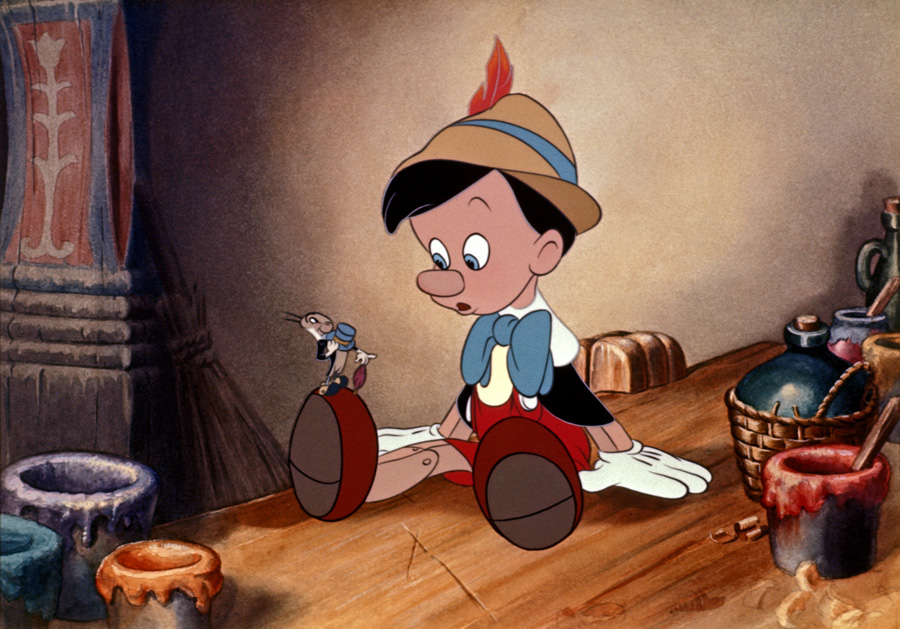
Characters from Walt Disney Picture's 'Pinocchio' Visit Magic Kingdom Park

The story of a wooden puppet who becomes a real boy captured the hearts of moviegoers, and introduced Pinocchio, Geppetto, the Blue Fairy and Jiminy Cricket who are now often seen in our theme parks. (Can you even imagine Wishes without Jiminy as the narrator?) 

Characters from Walt Disney Picture's 'Pinocchio' Visit Magic Kingdom Park

In August 1978 at Magic Kingdom Park, Pinocchio and Geppetto along with Stromboli, Lampwick, Gideon, J. Worthington Foulfellow and the marionettes posed together in Fantasyland. 

While Stromboli and Lampwick are not often seen around the Disney Parks, if you do ever run into them just remember Jiminy’s advice and “always let your conscience be your guide.”


Wednesday, March 7, 2012

The Land Developed at Walt Disney World

Q: I was surprised to hear on a recent trip to Walt Disney World that one third of the land at Walt Disney World is developed and two thirds have not been developed. Is that true? 
Gilbert, South Lyon, Michigan 
 
A [Dave Smith]: That is correct. According to the Reedy CreekImprovement District, over two-thirds of the 25,000 acres that currently encompass the Walt Disney World property are undeveloped. About 7,500 acres represent permanently protected streams and wetlands which provide aesthetic beauty and a sanctuary for wildlife.


[Marcio Disney]


The Reedy Creek Improvement District 2020 Plan is intended to provide the basis for future decisions regarding land use, development, conservation and infrastructure. It serves as the District's official policy for the use of both private and public lands, as well as the Comprehensive Plan for the Cities of Bay Lake and Lake Buena Vista. The Plan provides a framework for expansion of the unique uses in the District, while managing growth, protecting the environment, ensuring health and safety, and enhancing the quality of development. It continues the high standard of planning already undertaken and extends its purview ten years into the future.

The Plan's three overall functions are: 1) to govern the location and intensity of land use and development by providing the foundation for regulating proposed new projects; 2) to convey advance direction to the private sector by stating clearly the District's expectations for growth and conservation; and 3) to guide public investment in new facilities, such as roads, water, wastewater and solid waste systems, and water quality facilities.


Wednesday, December 7, 2011

The Original Admission price to Disneyland & 1st Ticket Book

Q: How much was the original admission price to Disneyland, and when were the ticket books introduced?
Jackie, El Cajon, California 

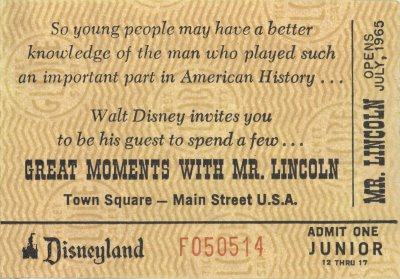
A [Dave Smith]: The original main gate admission price was one dollar, but that just got one in the gate. Guests had to pay at each individual attraction in the park. Ticket books were first issued on October 11, 1955.

[Marcio Disney

           The first ticket to Disneyland was bought by Roy O. Disney, who for decades kept it in the top desk drawer of his office. It's shown here as a preserved artifact in the Disney Archive. (Christina House/Los Angeles Times)


Friday, December 2, 2011

The Little Girl in the First Scene of Carousel of Progress

Q: In the first scene in the Carousel of Progress, a little girl is helping Sarah with the laundry. She is not mentioned by name and does not appear in any other scenes. My discussion board buddies at allears.net are dying to know the answer.
Debbie, Hamilton Square, New Jersey 

A [Dave Smith]: She was never named. 


[Marcio Disney

Tuesday, November 29, 2011

Gonzo from The Muppets

Q: What kind of animal is Gonzo from The Muppets?
Angela, Philadelphia, Pennsylvania
  
A [Dave Smith]: His is not supposed to be based on any recognizable animal; he has been called a “whatever.”

 [Wikipedia]

Gonzo the Great (or simply Gonzo) is a puppet character, one of Jim Henson's Muppets. He was developed and performed by Dave Goelz. The character made his first appearance in a 1970 Christmas special entitled "The Great Santa Claus Switch". Known as a "Whatever" (or a "Weirdo" on Muppet Babies), he is considered one of The Frackles. Since his character lived in a cigar box, he was called the "Cigar Box Frackle". Originally a minor figure on The Muppet Show, he soon evolved into one of the franchise's principal characters.

He is voiced by Russi Taylor in Jim Henson's Muppet Babies and by Hal Rayle in the ill-fated Jim Henson's Little Muppet Monsters. He appeared in the premiere episode of Studio DC: Almost Live in 2008. In the 1999 film Muppets from Space, it is revealed that he is an alien from a distant planet in space and he meets his alien family for the first time.


Tuesday, November 8, 2011

Dave Smith Collection - Magic Kingdom Opens [Disney Pin]


Name:
"Dave Smith Collection - Magic Kingdom® Park Opens"
Release Date:
11/05/05
Location:
Walt Disney World® Resort
SKU:
10904073
Retail:
$10.95
Edition Size:
2000
Dave Smith, director of the Walt Disney Company Archives and long-time Disney Historian, has selected the top 20 moments in Disney Theme Park History. This pin celebrates the first Disney Theme Park in Florida - the Magic Kingdom® Park.

This Limited Edition pin features Mickey Mouse sitting on a bench in the Magic Kingdom® Park. The yellow balloon next to Mickey is "free-d" - Fastened Rubber Element on a pin for Extra Dimension. The "Dave Smith Medallion" is a pin-on-pin. Martha Widener from Disney Design Group created the artwork for this pin. It is #7 out of 20 in the Dave Smith collection.
Dave says, "The Magic Kingdom® Park at Walt Disney World® Resort opened in Florida on October 1, 1971."

Please contact Walt Disney World® Merchandise Guest Services at 407-363-6200 or via e-mail: wdw.mail.order@disneyworld.com to check availability of ordering this pin. If sending an e-mail, please include "Attn: Pins" in the subject line. All Limited Edition pins are available while supplies last, and may not be available via Walt Disney World® Mail Order at time of inquiry.
Please Note - All information is subject to change including but not limited to artwork, release dates, edition sizes and retail prices.

Tuesday, October 18, 2011

Disney Archivist Dave Smith with the first Disneyland attraction vehicle ever sold at a Disneyana convention


10.18.11 – Walt Disney World hosts its first Disneyana convention, as told by Dave Smith in 1992.


Disney Archivist Dave Smith with the first Disneyland attraction vehicle ever sold at a Disneyana convention.

Whether it’s early Mickey Mouse watches, original cartoon cels, recent limited edition figurines, or 1955 Disneyland guide­books, Disneyana collectibles have a fascination for Amer­icans young and old. And, with the opening of Disney Parks in Japan and France, and the expansion of The Disney Stores throughout the world, what started as an American hobby has grown to where it is enjoyed worldwide today.

To provide an event where Disneyana fans could gather together for several days of collecting, guest speakers, good food, special merchandise, and the fun experi­ence of a Disney Theme Park, Walt Disney World Attractions hosted its first Disneyana Convention. Held September 24-27, the Convention Center drew over 750 Disneyana collectors and fans to Disney’s Contemporary Resort.
Guests arriving on Thursday morning took care of their hotel check-in and convention registration, then rushed to the Disneyana Collectible Shop where special merchandise featuring the convention logo had been placed on sale. Eager collectors grabbed up ornaments, decals, buttons, T-shirts, spoons, and even stropping bags. The hottest items were a $25 plate—in a limited supply of just 500—and a watch. One watch had been given to each registrant, winch left less than 500 available for sale.

The convention began in earnest Thursday evening with a welcome reception Ice Cream Social. The Fantasia Lobby was decked out with banners flags, park benches, gazebos, and greenery, along with tables loaded with ice cream, pastries, and other delectable taste treats. Disney characters were on hand to greet guests, and as a special added attraction, three of the original Mousketeers—Bobby, Sharon and Sherry—were there to autograph photographs in a Mousketeer Clubhouse in the West Rotunda.
Friday dawned with a buffet breakfast outdoors in front of the Convention Center. Mickey Mouse and Dick Nunis, Chairman of Walt Disney Attractions, made a grand entrance in the LiMOUSEine. Other members of Mickey’s gang gathered with some of the Park’s singers and dancers for a couple of musing numbers to lead guests into the Fantasia Ballroom for the opening session.

After the surprise entrance of the Voice of Disney—Jack Wagner—to emcee the events, the morning got off to an exciting start with a kinetic audio-visual presentation covering the history of The Walt Disney Company. The morning speakers were Dick Nunis, reminiscing on his many years with Disney, landscaper Bill Evans sharing experiences in creating the natural scenery in all of the Disney Parks, Max Howard speaking on the expansion of the feature animation division in Florida and showing pre­views of Aladdin, and Esther Ewert of Disney Art Editions, relating the history of Disney animation art in the market­ place. The climax of the morning ses­sion was the introduction of the Al­addin characters in a festive parade complete with a live camel and horses.

For the afternoon, convention-goers had many choices. They could attend a Limited Edition sale and Artist Signing, where a number of very special pieces had been created especially for the convention by the likes of Lladro Goebel, Armani, R. John Wright, Ron I.ee, Laurenz, and others. Nearby was a Disneyana Fair, where Disney signs, artwork, and props—many never before offered for sale—could be purchased.

There was a preview of auction items, and, upstairs, a Disney Business Group Presentation included displays from Disney Art Editions, Disney Stores, Disney Vacation Club, Disney Gallery, Disney Classics Collection, The Disney Channel, Disney Publishing, the Magic Kingdom Club and other divisions of the Disney organization. Finally, down the hall was a Disneyana Trade Show where independent dealers displayed their wares. It was almost more than a collector could han­dle in one day.

The day was capped by a thrilling Disneyana auction, with selected pieces from the Disney vaults bringing record prices. An original Dumbo attraction unit from Disneyland brought $16.000, as did a bronze-cast Mickey Mouse statue. A Carousel horse brought $4,000 and the art for a Little Mermaid plate $8,250.

At Saturday morning’s session, my assistant, Robert Tieman and I had the thrill of being delivered into the banquet with Mickey Mouse it an armored truck, bring­ing 30 Treasures of the Walt Disney Archives for show and-tell. Tony Baxter, from Walt Disney Imagineering, brought insight into Euro Disneyland’s design, and a high­light was a conversation with 98-year-old Joe Fowler, builder of Disneyland and Walt Disney World.

The public was allowed to join conven­tioneers at the various fairs and trade shows on Saturday and then the convention culminated with a deli­cious banquet, followed by comments by Dick Nunis, and Bob Bowman and Bo Boyd of Disney Consumer Products. The Kids of the Kingdom brought the house down with The Best of Disney and each guest received a valuable medallion as a keepsake.
It was an exhausting three days, but those in attendance praised the conven­tion planners. The First Disneyana Convention had been a rousing success. Now, off to Anaheim for the next one in September, 1993.

From Disney News, Winter 1992.

Monday, July 18, 2011

Walt Disney's Wonderful World of Color - All About Magic

Q: How could one go about viewing an episode of Walt Disney's Wonderful World of Color that originally aired on January 30, 1957 entitled "All About Magic"?
Mitch, Cave Creek, Arizona

A [Dave Smith]: Until they are released on DVD, the early Disney television shows are unavailable. But this one was released on The Sword in the Stone (Gold Collection); the DVD was released in 2001. 

[Marcio Disney]


"Walt Disney began hosting his own television show for ABC in 1954 in an unusual contract: Disney provided ABC with a weekly hour-long television program in exchange for funding for the construction of Disneyland. As a result, the television show was also originally named Disneyland. The anthology series has since gone through a number of name changes over the years: Walt Disney Presents, Walt Disney's Wonderful World of Color, The Wonderful World of Disney, Disney's Wonderful World, Walt Disney, The Disney Sunday Movie, and The Magical World of Disney. The series spanned an incredible 54 years—13 seasons of which were hosted by Walt Disney, himself.

Walt shows off some magic tricks with the studio props and then turns the show over to the Slave in the Magic Mirror, who hosts a look at some magic-themed cartoons.

Aired on Wednesday, January 30th, 1957 on ABC at 7:30pm
Aired on Wednesday, June 12th, 1957 on ABC at 7:30pm
Aired on Sunday, October 23rd, 1960 on ABC at 6:30pm (under the heading of Walt Disney Presents)"


Saturday, July 16, 2011

When Mary Poppins Flew Over Sleeping Beauty Castle

Q: Some of my favorite childhood memories are of visiting Disneyland with my parents, two sisters and brother in the 1960s. This may be just a fanciful childhood memory, but I seem to recall that during that time period, in addition to Tinker Bell's flight, from Matterhorn Mountain to Sleeping Beauty Castle, there was on occasion a flight of Mary Poppins, her umbrella up and carpet bag in hand. Is this just a wishful memory?
Donna, West Covina, California 

A [Dave Smith]: There was indeed a Mary Poppins who flew over Sleeping Beauty Castle in 1966.

[Marcio Disney]

 You can find the original article bellow in our The Best Disney Parks Videos blog!


Summer fireworks at Disneyland began way back in 1956. Five years later, the “Fantasy in the Sky” fireworks show debuted and ran until 2001. The next year a new show began, “Believe … There’s Magic in the Stars.” It ran for three summers. The summer of 2005 exploded with new fireworks in celebration of the 50th Anniversary of Disneyland. Guests were treated to “Remember … Dreams Come True,” a nighttime spectacular, narrated by the legendary Julie Andrews, that took guests on a nostalgic journey through the park’s history. It was a touching tribute to 50 years of magic. Last summer a new show lit up the sky. “Magical” premiered, and that’s the show currently running. Check out this video of the summer fireworks past and present, and then come see them in person.

Related Posts Plugin for WordPress, Blogger...