Friday, August 6, 2010

Sabotage by Alfred Hitchcock

Q: In the opening credits of the Hitchcock film Sabotage , there is a special thank you to Walt Disney for arranging the animated sequence. Later in the film a short clip from the Silly Symphony "Who Killed Cock Robin" is shown along with the song. Can you tell me how this came about? Was Walt a fan of Hitchcock and did they ever meet in person?
Donnie, Houston, Texas

A [Dave Smith]: We do not know about Walt being a Hitchcock fan, but actually there were a number of motion pictures made by other Studios which would license a clip of a Disney cartoon to have running when actors went into a movie theater. You can see Disney cartoon clips in such films as My Lips Betray (Fox, 1933), Michael O'Halloran (Republic, 1937), Sullivan's Travels (Paramount, 1941), Dillinger (Monogram, 1945), Portrait of Jennie (Selznick, 1948), 1941 (Universal, 1979), The Outsiders (Warner Bros., 1983) and Gremlins (Warner Bros., 1984).


[Just to Know by Marcio Disney]

Actually, we Do know a few things about Walt and Alfred! First things first: The US release title is A Woman Alone and it was based on Joseph Conrad's novel The Secret Agent. It should not be confused with Secret Agent or Saboteur, 2 different films by Hitchcock.

The similarities and connections between Disney and Hitchcock are intriguing. Both men enjoyed the sort of public recognition you would expect from people who starred in films, rather than just making them. Needless to say, they knew each other and admired each other’s work. Hitchcock, in particular, kept a watchful eye on whatever was going on at the Disney studios. He first paid tribute to Disney in one of his British films, Sabotage, during the uncharacteristically moving scene when Sylvia Sidney, horrified to have learnt not only that her young brother has died, but that her husband was responsible for the death, walks into a cinema auditorium where one of the Silly Symphonies cartoons is playing and can’t help but find herself laughing through her tears, caught up in the audience’s shared joy. Years later, whenever Hitchcock needed a particular special effect, it was usually from Disney that he would borrow it. The sodium process that made The Birds possible, for instance, or the fake bucking horse towards the climax of Marnie: both effects were supplied to him by Disney’s technicians. 

Perhaps the most important thing Hitchcock and Disney had in common, however, was their virulent streak of sadism. After all, they were both great film-makers, and therefore, almost by definition, they were both committed sadists of the first order.  


"We know we are in the hands of a master director in SABOTAGE. Hitchcock’s key visual elements here: signs of innocence – puppies, bird cages, a Disney cartoon, and warm meals – are given such a dark, chilling treatment that we never know where to turn or what happens next in this vastly under-rated classic."


"small imaginary creature blamed for mechanical failures," oral use in R.A.F. aviators' slang from Malta, Middle East and India said to date to 1923. First printed use perhaps in poem in journal "Aeroplane" April 10, 1929; certainly in use by 1941, and popularized in World War II and picked up by Americans (e.g. "New York Times" Magazine April 11, 1943). Possibly from a dial. survival of O.E. gremman "to anger, vex" + -lin of goblin; or from Ir. gruaimin "bad-tempered little fellow." Surfer slang for "young surfer, beach trouble-maker" is from 1961.


Sabotage   Starring Sylvia Sydney, Oscar Homolka.  Featuring Desmond Tester, John Loder, Joyce Barbour, Matthew Boulton, S. J. Warmington, William Dewhurst.  Screenplay by Charles Bennett.  From the novel 'The Secret Agent' by Joseph Conrad.  Continuity by Alma Reville.  Photographed by Bernard Knowles.  Music by Louis Levy. Cartoon sequence courtesy Walt Disney.  Alfred Hitchcock committed a shocking murder in Sabotage (1936). Here, in one of the director's darkest works, a child unknowingly carrying a bomb is blown to pieces in the streets of London. The death of Stevie is a deliberate attempt to shock an audience not accustomed to elaborately orchestrated deaths of sympathetic characters - especially children. The crime defeats expectation so decisively that it is virtually an act of cinematic terrorism. Howard Barnes of the New York Herald Tribute reviewed Sabotage under its American title, The Woman Along. He spoke for most of the contemporary public when he wrote, "If your senses are easily shocked, you will find the photoplay frequently unbearable."
            
Hitchcock attributed his own dissatisfaction with Sabotage to the casting of John Loder as the detective. He would have preferred the physical and verbal grace of Robert Donat, who contributed to the success of The Thirty-Nine Steps but could not star in Sabotage due to illness. With Donat to complement the nuanced performances of Homolka and Sydney, softening the lurking evil with his suaveness, Sabotage might have had greater appeal.  But the real trouble with Sabotage is that it arrived ahead of its time. The deaths of the boy and the saboteur are as fully realized as the notorious shower scene in Psycho - and much more meaningful. Today the visual virtuosity of Sabotage repays viewing after viewing. - Mark Fleischmann.

            1936. 76 minutes. Black and White. Monaural. 1.33:1 aspect ratio. Great Britain.


Thursday, August 5, 2010

"It Gets You" performed by Ludwig Von Drake

Q: I really get a kick out of the song "It Gets You" performed by Ludwig Von Drake from the "Walt Disney Records: Archives Collection Volumes I and II," but can't find any information online about its origin or actual lyrics. Is there anything you could tell me about where this hilarious song came from?
Jarred, Newton, New Jersey

A [Dave Smith]: "It Gets You" was a song written by Richard M. and Robert B. Sherman for the Disney TV show "Carnival Time," starring Ludwig Von Drake. It aired on March 4, 1962.

[More Info by Marcio Disney]


ºoº
It Gets You (2:08) - 1961
Performed by Ludwig Von Drake (Paul Frees)
from the album - -Professor Ludwig Von Drake-


Everyday, Disney fans send dozens of questions for Disney Chief Archivist Dave Smith. Here are Dave's answers to your questions. Check back every day for a new post with a new question.

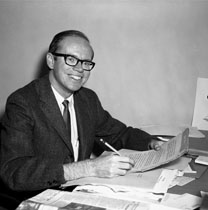
Dave Smith (born October 13, 1940) was the Walt Disney Archives founder and chief archivist which is located in the Frank G. Wells Building at Walt Disney Studios in Burbank, California. He joined the company June 22, 1970. Forty years later, on July 2010, he retired.


ºoº
ºoº Marcio Disney Family Sites Network ºoº

Disney's Dream Makers

Disney Picture of the Day

Vinylmation of the Day

Disney Tales [5 Weekly tales]

The Disney History

Marcio Disney Blog

Disney Pin of the Day

Marcio Disney Digital Media

Wednesday, August 4, 2010

How did Dave Smith get his job at Disney Archives

Q: How did you get your job? It is my dream to work at a Disney Museum some day. I have degrees in art history and anthropology. What could I do to one day have your job or a job like it?
Charlotte, Topeka, Kansas

A [Dave Smith]: We are not a museum in the Walt Disney Archives, but rather a research facility. My undergraduate college degree was in history, with a master's degree in library science. I had seven years of experience working in libraries (including the Library of Congress) before coming to Disney. The Disney Archives has a very small staff, and people tend to stay here a long time, so there are rarely any openings.

[Dave Smith Biography at Marcio Disney History Site]


Dave Smith (Archives)
Inducted 2007
Walt Disney Archives founder and chief archivist David R. Smith officially joined The Walt Disney Company on June 22, 1970, but his Disney roots are even deeper.

A fan of Disney films throughout his youth, Dave adds, "I grew up in Southern California, and so my appreciation of Disneyland began as a child." In 1967, he had become interested in compiling an extensive bibliography on Walt Disney. With approval from the Disney organization, he spent more than a year researching all Disney publications and productions.

When the Disney family and Studio management decided to attempt to preserve Walt Disney's papers, awards and memorabilia, it was natural for them to contact Dave to do a study, and make a recommendation which established the guidelines and objectives of the Archives. Dave was selected as archivist, and in the years since the Archives was established, it has come to be recognized as a model among corporate archives in the country?and Dave is regarded as the final authority on matters of Disney history.


Born on October 13, 1940, and raised in Pasadena, Dave graduated as valedictorian from both Pasadena High School and Pasadena City College. He earned his B.A. in history at the University of California at Berkeley. While in school, Dave worked part-time for six years in the Manuscript Department of the Huntington Library in San Marino.

Upon receiving his Masters Degree in Library Science from the University of California in June 1963, he was selected as one of seven outstanding graduates of library schools throughout the country to participate in an internship program at the Library of Congress in Washington.

He returned to California where he served for five years as a reference librarian at the UCLA Research Library. While there, Dave authored several articles and had bibliographies published on the Monitor and the Merrimac Civil War warships, and on Jack Benny.

Of his Disney role, Dave said, "The thing I like best is the tremendous variety in our work. We never know when we come to work in the morning what we'll be doing that day. It keeps the job interesting when you're not doing the same thing day in and day out."

Dave has written extensively on Disney history, with a regular column in The Disney Channel Magazine, Disney Magazine, Disney Newsreel, and numerous articles in such publications as Starlog, Manuscripts, Millimeter, American Archivist, and California Historical Quarterly. He is the author of the official Disney encyclopedia Disney A to Z (now in its third edition), with Kevin Neary he co-authored four volumes of The Ultimate Disney Trivia Book, with Steven Clark he co-wrote Disney: The First 100 Years, and he edited The Quotable Walt Disney. Dave has written introductions to a number of other Disney books.


"My greatest reward has been getting to know the many people who have come to use the Archives over the years. I have been especially proud to be a guide and mentor to so many young people who have gone on to exceptional careers in the Disney organization." Dave says humbly.

"I have had the pleasure and privilege to work with Dave Smith for nearly 35 years," author and animator John Canemaker says, "and, to me, he has always been legendary. For his steady building of the Disney Archives over the years into one of the greatest, most invaluable, world-class resources for studying American animation?and for his kindness and generosity to all researchers."


Click Here to see other Disney Legends :)


Everyday, Disney fans send dozens of questions for Disney Chief Archivist Dave Smith. Here are Dave's answers to your questions. Check back every day for a new post with a new question.

Dave Smith (born October 13, 1940) was the Walt Disney Archives founder and chief archivist which is located in the Frank G. Wells Building at Walt Disney Studios in Burbank, California. He joined the company June 22, 1970. Forty years later, on July 2010, he retired.


ºoº
ºoº Marcio Disney Family Sites Network ºoº

Disney's Dream Makers

Disney Picture of the Day

Vinylmation of the Day

Disney Tales [5 Weekly tales]

The Disney History

Marcio Disney Blog

Disney Pin of the Day

Marcio Disney Digital Media

Tuesday, August 3, 2010

Captain Hook's Real Name

Q: What was Captain Hook's name before he lost his hand?
Eric, Redondo Beach, California

A [Dave Smith]: That would have been a question for the original author of the play, Sir James M. Barrie. The character was also called Captain James Hook. According to Barrie, "Hook was not his true name. To reveal who he really was would even at this date set the country in a blaze."


1912 illustration by F. D. Bedford.


Captain James Hook is the villain of J. M. Barrie's Peter Pan. Hook is a pirate captain and Peter Pan's nemesis. It is said that he was Blackbeard's bosun, and that he was the only man Long John Silver ever feared. He wears an iron hook in place of his right hand, which was cut off by Peter Pan and eaten by a crocodile; the crocodile liked the taste of him so much that it followed him around for the rest of his life, hoping for more. He hates Peter obsessively, and lives for the day he can make him and all of his Lost Boys walk the plank.

(Lest anyone think Hook's name too convenient, Barrie notes that "Hook was not his true name. To reveal who he really was would even at this date set the country in a blaze.")

Barrie revealed at one point that the Captain was an Old Etonian.

In Barrie's play and novel, Hook kidnaps Wendy, the girl who loves Peter and who Peter views as his Mother, and challenges the boy to a final duel. He is bested, and, seeing a choice between surrender and death, commits suicide by throwing himself into the waiting jaws of the crocodile. Just before dying, however, he takes one last jab at Peter by taunting him about his bad manners. Peter, with the callousness of youth, quickly forgets him and finds a new nemesis, but, as Hook made a stronger impression on the public, most sequels brought him back one way or another.

The symbolism of Peter Pan's fight with Captain Hook (traditionally played by the same actor as Wendy's father), combined with Hook's fear of time via the crocodile could possibly hint at a Freudian subtext.

It is hypothesized that Captain Hook is modeled after the famous English captain Christopher Newport. Both were dark-haired captains of dubious pasts, and were missing their right hands which were replaced by a metal hook. Newport commanded the ships that landed the settlers at Jamestown in Virginia. He also seems to have a distinctive similarity with Bartholomew Roberts, especially regarding his choice of clothes and his impeccable manners.

There is another hypothesis which claims that this Captain James Hook could represent Captain James Cook, the British captain who discovered both Australia and New Zealand. The Lost Boys would symbolize the Maoris, who previously inhabited New Zealand, or the Aborigines, who inhabited Australia.

Smee is Captain Hook's right hand man, so to speak.

The version of Captain Hook who appeared in the Disney animated film adaptation of Peter Pan, a cowardly fool prone to crying out for his mother and has the hook in place of his left hand instead of his right, has subsequently appeared in a number of other Disney productions. He sometimes appears in comic book placed in the Scrooge McDuck universe of comic books as the nemesis of Moby Duck, a whaler cousin of Donald Duck. A Captain Hook-like character appears briefly in the animated film Shrek 2, where he plays piano in a tavern.


Monday, August 2, 2010

Seven Dwarfs - The Original Names

Q: What were the original names chosen for the seven dwarfs?
Vicky, Ontario, California

A [Dave Smith]: In 1934, the names first selected were Wheezy, Jumpy, Baldy, Grumpy, Doc, Happy and Sleepy. Four of those names were retained. Dozens of other names were suggested, with a few being Hickey, Sniffy, Stuffy, Burpy, Tubby, Shorty and Dizzy.


[More to Know About Snow White by Marcio Disney]

Deafy is a happy sort of fellow - he always tries to make clever remarks, but he misinterprets other people's attitudes toward him. He feels, lots of times, that they are saying something about him, or that they have made some remarks, which they haven't at all - he takes exception to the most ridiculous things. Throughout the picture Deafy and Grumpy  are always clashing. Deafy will pick up one word of the conversation in the early part, and whereas the conversation topic might have changed completely, he still sticks to the first thing that he heard, and in this way we hope to get some comical situations out of Deafy.
—Story draft for Snow White and the Seven Dwarfs, made in early 1936.


Differences from fairy tale

Though Disney's Snow White and the Seven Dwarfs is similar to the fairy tale version, there are several differences. In the fairy tale, Snow White's mother wishes for a child with "lips as red as blood, hair as dark as the window frame, and skin as white as snow". This does not occur in the film, as Disney's Snow White is shown with only her stepmother, the Queen, and there is no scene of her biological mother.

In the fairy tale, Snow White accepts three gifts from the witch (a girdle, a poisoned comb, and the apple), but is rescued from the first two gifts by the dwarfs. When she is offered the apple, she is unwilling to eat it and only accepts after the witch takes a bite of the apple that is not poisoned. However, in the film, Snow White only accepts one gift (the apple) from the witch after she helps the witch inside the dwarfs' house (some of the woodland birds attacked the witch as a warning, which was misinterpreted by Snow White). She bites the apple after being told that the apple is magical and that one bite will make all of her dreams come true (namely marrying the Prince).

In the fairy tale, Snow White is not awakened by the prince's kiss. Instead, the prince buys the coffin and Snow White's body from the dwarfs and has it carried with him towards his castle. During the journey, a piece of apple in Snow White's throat becomes dislodged and she awakens.

Lastly, in the fairy tale, Snow White faces her stepmother one final time after eating the poisoned apple. The stepmother attends the wedding of Snow White and the prince, but she is stopped from causing further harm by being forced to wear hot iron shoes to her death. In the film, the stepmother (as the witch) is chased up to the top of a mountain by the dwarfs after giving Snow White the poisoned apple: when she tries to dislodge a boulder onto the dwarfs to kill them, lightning strikes the edge she is standing on and she falls to her death, along with the boulder falling and presumably crushing her.


Wikipedia

Snow White and the Seven Dwarfs is a 1937 American animated film based on Snow White, a fairy tale by the Brothers Grimm. It was the first full-length cel-animated feature in motion picture history, as well as the first animated feature film produced in America, the first produced in full color, the first to be produced by Walt Disney, and the first in the Walt Disney Animated Classics canon.[3]

Snow White and the Seven Dwarfs premiered at the Carthay Circle Theatre on December 21, 1937, and the film was released to theaters by RKO Radio Pictures on February 4, 1938. The story was adapted by storyboard artists Dorothy Ann Blank, Richard Creedon, Merrill De Maris, Otto Englander, Earl Hurd, Dick Rickard, Ted Sears and Webb Smith from the German fairy tale Snow White by the Brothers Grimm. David Hand was the supervising director, while William Cottrell, Wilfred Jackson, Larry Morey, Perce Pearce, and Ben Sharpsteen directed the film's individual sequences.

Snow White and the Seven Dwarfs was one of only two animated films to rank in the American Film Institute's list of the 100 greatest American films of all time in 1997 (the other being Disney's Fantasia), ranking number 49. It achieved a higher ranking (#34) in the list's 2007 update, this time being the only traditionally animated film on the list. The following year AFI would name the film as the greatest American animated film of all time and the best ever Walt Disney Animated Classics movie.

In 1989, the film was added to the United States National Film Registry as being deemed "culturally, historically, or aesthetically significant".


The names of the Seven Dwarfs (Bashful, Doc, Dopey, Grumpy, Happy, Sleepy and Sneezy) were created for this production, chosen from a pool of about fifty potentials. The one name Disney always had in mind from the start was Grumpy, or something similar. Blabby, Jumpy, Shifty, and Snoopy were among those that were rejected, along with Awful, Baldy, Biggo-Ego, Biggy, Biggy-Wiggy, Burpy, Busy, Chesty, Cranky, Daffy, Dippy, Dirty, Dizzy, Doleful, Flabby, Gabby, Gloomy, Goopy, Graceful, Helpful, Hoppy, Hotsy, Hungrey, Jaunty, Lazy, Neurtsy, Nifty, Puffy, Sappy, Sneezy-Wheezy, Sniffy, Scrappy, Silly, Soulful, Strutty, Stuffy, Sleazy, Tearful, Thrifty, Tipsy, Titsy, Tubby, Weepy, Wistful, and Woeful.


It was called "Disney's Folly." Who on earth would want to sit still for 90 minutes to watch an animated cartoon? And why pick a well-worn Grimm's Fairy Tale that every schoolkid knows? But Walt Disney seemed to thrive on projects which a lesser man might have written off as "stupid" or "impossible". Investing three years, $1,500,000, and the combined talents of 570 artists into Snow White and the Seven Dwarfs, Disney produced a film that was not only acknowledged a classic from the outset, but also earned 8,500,000 depression-era dollars in gross rentals. Bypassing early temptations to transform the heroine Snow White into a plump Betty Boop type or a woebegone ZaSu Pitts lookalike, the Disney staffers wisely made radical differentiations between the "straight" and "funny" characters in the story. Thus, Snow White and Prince Charming moved and were drawn realistically, while the Seven Dwarfs were rendered in the rounded, caricatured manner of Disney's short-subject characters. In this way, the serious elements of the story could be propelled forward in a believable enough manner to grab the adult viewers, while the dwarfs provided enough comic and musical hijinks to keep the kids happy. It is a tribute to the genius of the Disney formula that the dramatic and comic elements were strong enough to please both demographic groups. Like any showman, Disney knew the value of genuine horror in maintaining audience interest: accordingly, the Wicked Queen, whose jealousy of Snow White's beauty motivates the story, is a thoroughly fearsome creature even before she transforms herself into an ancient crone. Best of all, Snow White  clicks in the three areas in which Disney had always proven superiority over his rivals: Solid story values (any sequence that threatened to slow down the plotline was ruthlessly jettisoned, no matter how much time and money had been spent), vivid etched characterizations (it would have been easier to have all the Dwarfs walk, talk and act alike: thank heaven that Disney never opted for "easy"), and instantly memorable songs (Frank Churchill, Leigh Harline, Paul J. Smith and the entire studio music department was Oscar-nominated for such standards-to-be as "Whistle While You Work" and "Some Day My Prince Will Come")


Friday, July 30, 2010

Is an 8mm reel-to-reel collectible?

Q: I have an 8mm reel-to-reel Disney cartoon that I watched when I was a child some 50 years ago. Is it collectible?
Carol, Pensacola, Florida


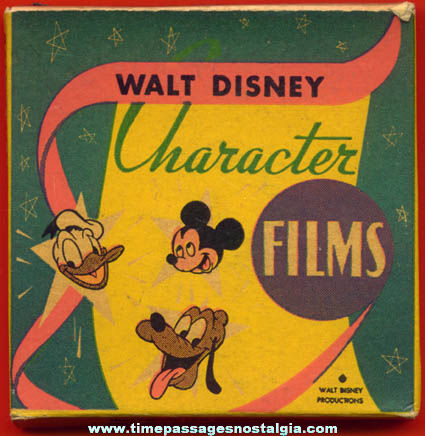
A [Dave Smith]: The old 8mm film versions of Disney cartoons are practically valueless today. Few people have projectors, the films have gotten brittle and practically all the films have been released on video cassette or DVD.


About 8mm [Marcio Disney]


"Eight millimeter" film is one of the oldest movie formats, that was first introduced in 1932.

Eight-millimeter film dominated the amateur market for thirty years, until Kodak decided to improve every aspect of the format, calling it, Super 8. 8mm film has almost completely disappeared from the home movie market. Today it finds use in Television Applications, some Documentary Films and Music Television.


CLICK HERE TO SEE A KODAK COMMERCIAL AT DISNEY [YOUTUBE]
[It's a Jungle Cruis Tribute video and the commercial recorded by Ed Sullivan starts at 2:13 ]


Most common 8mm and Super8 reels – 3" – can hold up to 50 feet of film, which is approximately 3-4 minutes of video.


There are larger reels as well:

    5" - 200 feet of film;

    6" - 300 feet;

    7" - 400 feet;

    8" - 600 feet;

    9 3/4" - 800 feet;

    10 1/2" - 1200 feet.


Everyday, Disney fans send dozens of questions for Disney Chief Archivist Dave Smith. Here are Dave's answers to your questions. Check back every day for a new post with a new question.

Dave Smith (born October 13, 1940) was the Walt Disney Archives founder and chief archivist which is located in the Frank G. Wells Building at Walt Disney Studios in Burbank, California. He joined the company June 22, 1970. Forty years later, on July 2010, he retired.


Follow the links below to see our daily posts:


The Walt Disney World Picture of the Day
The Disney's Pin of the Day
The Disney's Vinylmation of the Day
http://vinylmationoftheday.blogspot.com/

The Daily Mickey [Comics]
http://tinyurl.com/DailyMickey

The Daily Donald [Comics + Cartoons]
http://tinyurl.com/DailyDonald

Fun Fact of the Day
http://tinyurl.com/DisneyFunFact

This Day in Disney History
http://tinyurl.com/TodayDisneyHistory


And meet our other blogs and sites:

Marcio Disney Blog
[Blog]
[Site]
http://sites.google.com/site/marciodisney/

Disney Tales [5 weekly tales]

The Disney History

Disney Archives
http://marciodisneyarchives.blogspot.com/

Thursday, July 29, 2010

Mary Poppins Original Costumes

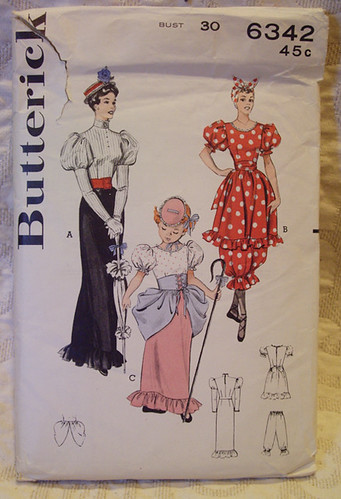
Q: Does the Disney Archives hold any original costumes from the live-action films (e.g., Mary Poppins)?
Keith, London, England

A [Dave Smith]: Yes, the Archives has always had some live-action costumes, and beginning a few years ago, we greatly added to that collection from the Studio's Costume Department. We regularly select costumes today after new movies and television shows complete filming.


 Pattent

Wednesday, July 28, 2010

Audio-Animatronics

Q: Disney revolutionized theme park entertainment with Audio-Animatronics®. What are the oldest Audio-Animatronics® still being used at Disney Parks? Which is the most complex? What is the largest?
Ryan-Philippe, North Hills, California

A [Dave Smith]: While they have been upgraded through the years, the first Disneyland show with Audio-Animatronics® was the Enchanted Tiki Room in 1963. Human figures were first created for the 1964 New York World's Fair; the humans in the Carousel of Progress and Great Moments with Mr. Lincoln were later added to Disneyland. The largest figures were the dinosaurs in Universe of Energy at Epcot and the mammoth Yeti in Expedition Everest, but the tallest one currently is the new Maleficent in Fantasmic! at Disneyland. The most complex early figure was probably Abraham Lincoln for the Fair — he was later simplified because he had possibly been made too elaborate, which caused maintenance issues. But the new Lincoln figure [since December 2009] at Disneyland is again sophisticate, with 20 functions in the head and face as opposed to seven in the preceding figure. Today some other Audio-Animatronics® have very realistic movements — such as the auctioneer in Pirates of the Caribbean and the Wicked Witch of the West in the Oz scene in The Great Movie Ride — or can even walk around, like Lucky the Dinosaur. Other complex figures today are Mr. Potato Head in Toy Story Midway Mania! and Stitch in Stitch's Great Escape. 


Chef Remy Video and Audio-Animatronics Timeline [Marcio Disney]


Early 1950s
Walt Disney purchases a mechanical bird while vacationing in Europe. The souvenir becomes the inspiration for Audio-Animatronics technology.

1951
Work begins on “Project Little Man.”  Roger Broggie and Wathel Rogers, pioneers in Audio-Animatronicstechnology, create a miniature figure that is programmed with cams, cables and tubes to mimic tap-dancing routines performed by the late Buddy Ebsen.

1963


Walt Disney’s Enchanted Tiki Room opens at Disneyland.  It’s the first show to feature Audio-Animatronics technology.


1964

The world’s first fully animated human figure, Abraham Lincoln, debuts at the New York World’s Fair in Great Moments with Mr. Lincoln.  The figure causes a sensation, not just with the audience, but with Disney Imagineers, who were able to complete the figure in half the time they anticipated.

Audio-Animatronics figures are also in three other World’s Fair shows designed and produced by Disney: Carousel of Progress (featuring figures animated using a programming harness, a precursor of today’s motion capture systems), Magic Skyway and it’s a small world.

1964


Two Audio-Animatronics birds, Robin and Umbrella, appear in “Mary Poppins.”  Walt Disney reinvests profits from the film to create MAPO, an organization within Walt Disney Imagineering dedicated to creating and innovating Audio-Animatronics figures.

1965
Great Moments with Mr. Lincoln – featuring the Audio-Animatronics figure of Abraham Lincoln (actually, a duplicate since the original was still performing at the World’s Fair) – opens at Disneyland.

1970
Audio-Animatronics technology enters the computer age with the use of DACS (Digital Animation Control System), a computer-controlled playback system for Disney shows and attractions.  Imagineers also begin using the Anicon-Animation Console – for animating and programming figures.

1989


The first A-100 Audio-Animatronics figure, the Wicked Witch of the West, debuts as part of The Great Movie Ride at Disney’s Hollywood Studios (then known as Disney-MGM Studios) in Walt Disney World Resort.  A-100 figures incorporate compliance technology that gives the characters more fluid and realistic movements.

1992


Pirates of the Caribbean opens at Disneyland Paris.  Attraction features sword-fighting pirates figures.

1998


Hopper, the grasshopper from the Disney•Pixar film “A Bug’s Life,” is the most sophisticated Audio-Animatronics figure produced to date.  Featuring 74 functions, the character appears in “It’s Tough to be a Bug!”

2002
The first portable, all-electric Audio-Animatronics figure, Meeko, the raccoon from the Disney animated film “Pocahontas,” appears.  He’s in a basket carried by Pocahontas.

2003


The first totally autonomous Audio-Animatronics figure, Lucky the Dinosaur, makes his debut, at Disney’s California Adventure.

2006


The yeti, a major element of Expedition Everest at Disney’s Animal Kingdom, is the largest and most powerful Audio-Animatronics figure ever created by Walt Disney Imagineering. Standing more than 18 feet tall, the thrust of the yeti’s arm has the equivalent amount of force as a 747 jumbo jet.

2007


The Muppet Mobile Lab, featuring Muppets Dr. Bunsen Honeydew and his assistant Beaker, marks the first time that free-roaming Audio-Animatronics characters can interact and converse with each other, as well as with guests they encounter along their way.

2008

2009
Mr. Potato Head in Toy Story Mania! at both Disney’s California Adventure and Disney’s Hollywood Studios marks the first time that anAudio-Animatronics figure features lips with such a wide range of lifelike movements, can remove and re-attach a body part (his ear) and has digitally animated eyes that can look directly at the particular guest with whom he is conversing. Also, since Mr. Potato Head has more lines of dialogue than any Audio-Animatronics figure ever created by Walt Disney Imagineering, it has required more programming hours than any other figure.
 
Chef Remy, the lovable star of the Disney/Pixar film "Ratatouille," who is the smallest Audio-Animatronics in the world, is appearing six days a week, four times a day at Les Chefs de France in the France pavilion at Epcot.


Everyday, Disney fans send dozens of questions for Disney Chief Archivist Dave Smith. Here are Dave's answers to your questions. Check back every day for a new post with a new question.

Dave Smith (born October 13, 1940) was the Walt Disney Archives founder and chief archivist which is located in the Frank G. Wells Building at Walt Disney Studios in Burbank, California. He joined the company June 22, 1970. Forty years later, on July 2010, he retired.


Follow the links below to see our daily posts:


The Walt Disney World Picture of the Day
The Disney's Pin of the Day
The Disney's Vinylmation of the Day
http://vinylmationoftheday.blogspot.com/

The Daily Mickey [Comics]
http://tinyurl.com/DailyMickey

The Daily Donald [Comics + Cartoons]
http://tinyurl.com/DailyDonald

Fun Fact of the Day
http://tinyurl.com/DisneyFunFact

This Day in Disney History
http://tinyurl.com/TodayDisneyHistory


And meet our other blogs and sites:

Marcio Disney Blog
[Blog]
[Site]
http://sites.google.com/site/marciodisney/

Disney Tales [5 weekly tales]

The Disney History


Tuesday, July 27, 2010

Disneyland's Indian Chief known as White Horse

Q: My late Great Uncle Truman Dailey use to work in Disneyland in the '50s or '60s as an Indian Chief known as White Horse. He was of the Otoe-Missouria tribe and I remember when my uncle came to visit he brought a program that he was featured in. For the life of me I could never find it. Would you have any information on him?
Kelley, Seminole, Oklahoma 
A [Dave Smith]: We generally do not have information on specific Disneyland Cast Members, but it is wonderful to know this information about your great uncle. There was an Indian Village at the park from 1955 to 1971, and Disneyland visitors fondly remember the Native- American dancers, as they would teach their dances to young guests.


Pictures [Marcio Disney]

Indian Chief known as White Horse


Indians Dancing


Everyday, Disney fans send dozens of questions for Disney Chief Archivist Dave Smith. Here are Dave's answers to your questions. Check back every day for a new post with a new question.

Dave Smith (born October 13, 1940) was the Walt Disney Archives founder and chief archivist which is located in the Frank G. Wells Building at Walt Disney Studios in Burbank, California. He joined the company June 22, 1970. Forty years later, on July 2010, he retired.


Follow the links below to see our daily posts:


The Walt Disney World Picture of the Day
The Disney's Pin of the Day
The Disney's Vinylmation of the Day
http://vinylmationoftheday.blogspot.com/

The Daily Mickey [Comics]
http://tinyurl.com/DailyMickey

The Daily Donald [Comics + Cartoons]
http://tinyurl.com/DailyDonald

Fun Fact of the Day
http://tinyurl.com/DisneyFunFact

This Day in Disney History
http://tinyurl.com/TodayDisneyHistory


And meet our other blogs and sites:

Marcio Disney Blog
[Blog]
[Site]
http://sites.google.com/site/marciodisney/

Disney Tales [5 weekly tales]

The Disney History


Monday, July 26, 2010

999 Happy Haunts at the Haunted Mansion

Q: This may be a question that is obvious or one that has been asked before... or perhaps just assumed, in any case. I know that the Haunted Mansion's Ghost Host states that the Mansion houses 999 Happy Haunts, and I was wondering if there are actually 999 ghosts in the Haunted Mansion or does that number include the tombstones and any other sort of reference that is not directly a ghost.
Janet, Windermere, Florida

A [Dave Smith]: One could probably not count all 999 ghosts in the Haunted Mansion, but the rest are there around you, invisible as ghosts are wont to be.

Picture and art by Marcio Disney at: http://tinyurl.com/MDLibSquare


INTERESTING FACTS [allears.net]

ºoº The Haunted Mansion is the only attraction featured in different lands at each of the four Disney theme parks worldwide:
   Disneyland -- New Orleans Square
Magic Kingdom -- Liberty Square
Tokyo Disneyland -- Fantasyland
Disneyland Paris (where it is known as Phantom Manor) -- Frontierland

ºoº The singing busts in the graveyard scene warble the attraction’s theme song, "Grim Grinning Ghosts." Though sometimes mistaken for Walt Disney, the face on the bust on the left actually belongs to Thurl Ravenscroft, the song's soloist. Ravenscroft is best-known as the voice of Tony the Tiger, the mascot of Kellogg's Frosted Flakes cereal. In addition to Ravenscroft, the Singing Busts include Jay Meyer, Verne Row, Bob Ebright, and Chuck Schroeder


ºoº Grim Grinning Ghosts, with lyrics by X Atencio (who also wrote the Ghost Host’s script) and music by Buddy Baker, was recorded by the Mello Men, a singing group made up of Bill Lee, Max Smith, Bob Stevens, and Thurl Ravenscroft. The group also provided the vocals in many of the Disney films and theme park attractions.

ºoº Legendary voice artist Paul Frees -- known to many as Boris Badenov from "The Rocky & Bullwinkle Show"-- is the attraction's narrator, or "Ghost Host." He also provided the voices for most of the rogues in Disney's Pirates of the Caribbean attraction.


Everyday, Disney fans send dozens of questions for Disney Chief Archivist Dave Smith. Here are Dave's answers to your questions. Check back every day for a new post with a new question.

Dave Smith (born October 13, 1940) was the Walt Disney Archives founder and chief archivist which is located in the Frank G. Wells Building at Walt Disney Studios in Burbank, California. He joined the company June 22, 1970. Forty years later, on July 2010, he retired.


Follow the links below to see our daily posts:


The Walt Disney World Picture of the Day
The Disney's Pin of the Day
The Disney's Vinylmation of the Day
http://vinylmationoftheday.blogspot.com/

The Daily Mickey [Comics]
http://tinyurl.com/DailyMickey

The Daily Donald [Comics + Cartoons]
http://tinyurl.com/DailyDonald

Fun Fact of the Day
http://tinyurl.com/DisneyFunFact

This Day in Disney History
http://tinyurl.com/TodayDisneyHistory


And meet our other blogs and sites:

Marcio Disney Blog
[Blog]
[Site]
http://sites.google.com/site/marciodisney/

Disney Tales [5 weekly tales]

The Disney History


Related Posts Plugin for WordPress, Blogger...